In light steel framing, many builders assume one simple rule: thicker steel means a stronger wall.
While that sounds logical, it is only partially true.
The relationship between structural capacity vs gauge thickness is far more complex than most people realize. In many cases, builders increase gauge thickness expecting major performance gains, only to discover that the real limiting factor was something else entirely.
For projects across Ontario, misunderstanding this relationship can lead to unnecessary material costs, inefficient designs, and even structural problems.
This guide explains what actually controls steel stud performance and why gauge thickness alone does not tell the full story.
Why Gauge Thickness Gets So Much Attention
Gauge thickness is one of the first things builders notice when comparing steel studs.
Heavier gauge studs feel stronger physically. They are harder to bend, heavier to lift, and appear more substantial on site.
Because of that, many people automatically associate thicker steel with higher structural performance.
But in cold-formed steel framing, structural behavior depends on much more than thickness alone.
That is where the misunderstanding begins.
Understanding Structural Capacity in Steel Studs
Structural capacity refers to how much load a steel stud can safely carry while maintaining stability and performance.
This includes:
- Axial load capacity
- Flexural strength
- Resistance to buckling
- Deflection performance
Gauge thickness influences these factors, but it is only one part of the equation.
The overall performance of a stud also depends on:
- Stud depth
- Profile geometry
- Yield strength of the steel
- Unbraced length
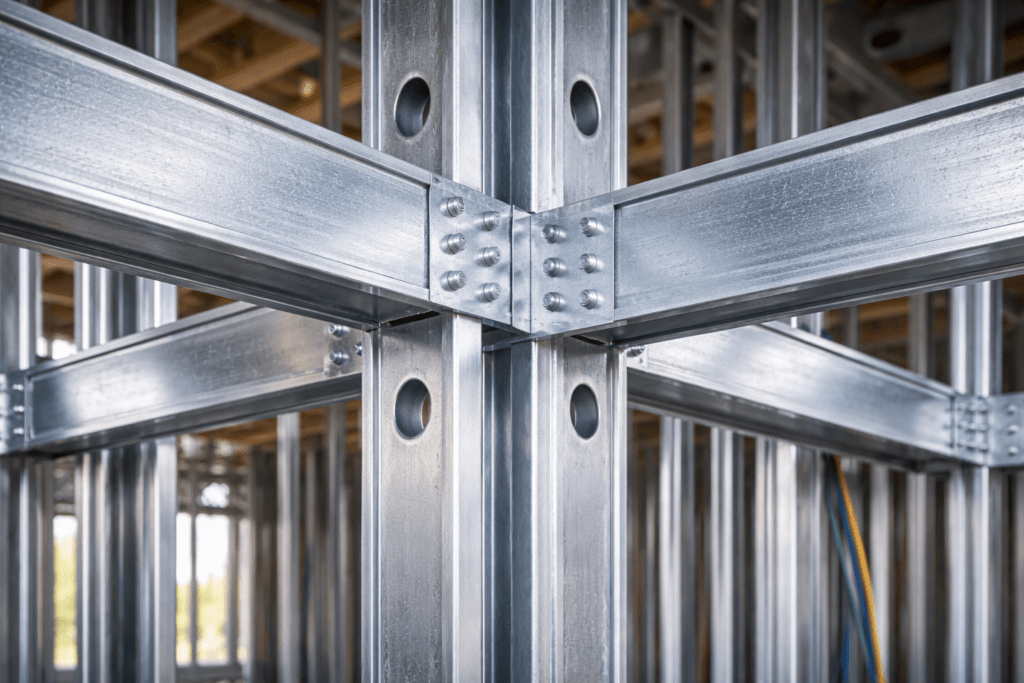
- Connection quality
- Load path continuity
Ignoring these factors often leads to poor assumptions about how a wall system actually performs.
Why Thickness Alone Does Not Prevent Failure
One of the biggest misconceptions in the structural capacity vs gauge thickness discussion is assuming that increasing thickness automatically solves structural problems.
In reality, many cold-formed steel failures are governed by buckling, not material strength.
A thicker stud may still fail if:
- It is too tall without proper bracing
- The load path is disrupted
- Connections are weak
- The stud depth is insufficient
This surprises many builders because the steel itself may still be far from its actual yield strength.
The issue is instability, not lack of material thickness.
Stud Depth Often Matters More Than Gauge
In many cases, increasing stud depth provides more structural benefit than increasing thickness.
A deeper stud has greater stiffness and better resistance to deflection and buckling.
For example, upgrading from a shallow stud to a deeper profile may improve wall performance more effectively than simply moving to a heavier gauge.
This is why engineers often optimize geometry before increasing material weight.
The most efficient wall systems are not always the thickest ones. They are the best-balanced ones.
Yield Strength Changes the Equation
Another factor builders often overlook is steel grade.
Two studs with the same gauge thickness may perform very differently if they use different yield strengths.
Higher-strength steel can significantly increase structural capacity without increasing thickness.
This is common in modern cold-formed steel systems, especially in engineered projects across Canada.
Without understanding steel grade, comparing studs by gauge alone becomes misleading.
Unbraced Length Is a Major Factor
Even a strong stud loses capacity when it is unsupported over long distances.
This is because slender members are sensitive to buckling.
Bridging, sheathing, and lateral bracing all play a major role in determining actual wall performance.
A lighter stud with proper bracing can outperform a heavier stud with poor support conditions.
This is another reason why structural capacity vs gauge thickness is not a simple comparison.
Why Builders Sometimes Overdesign
Because gauge thickness is easy to understand, many projects compensate for uncertainty by simply specifying heavier studs.
This approach increases:
- Material cost
- Weight
- Handling difficulty
- Installation effort
Without necessarily improving the system efficiently.
Overdesign often happens when builders focus on individual members rather than the behavior of the complete framing system.
Good engineering focuses on optimization, not just adding more steel.
Connection Quality Affects Capacity Too
Structural capacity depends heavily on connections.
Even a heavy-gauge stud will not perform properly if:
- Fasteners are incorrect
- Spacing is inconsistent
- Connections are misaligned
In cold-formed steel framing, load transfer between members is critical.
Poor connections can reduce the effective performance of the entire wall system regardless of gauge thickness.
Why Multi-Unit Projects Require Better Optimization
In multi-unit housing, small inefficiencies multiply quickly.
Overusing heavier gauge studs across an entire project can dramatically increase material and labour costs.
This is why optimization matters.
Developers who understand the relationship between structural capacity vs gauge thickness can reduce unnecessary weight while still achieving required performance.
That leads to:
- Better cost control
- Faster installation
- More efficient structural systems
The Difference Between Feeling Strong and Performing Strong
One reason this topic creates confusion is because heavier studs feel stronger physically.
But structural engineering is not based on feel. It is based on how loads move through the system.
A properly engineered lighter system can outperform a heavier but poorly designed one.
That is the difference between perceived strength and actual structural performance.
Why This Matters in Ontario Construction
Ontario projects are increasingly focused on efficiency, speed, and optimization.
Developers cannot afford unnecessary material costs or inefficient structural systems.
Understanding structural capacity vs gauge thickness allows builders to make smarter decisions and avoid overbuilding while still meeting code and performance requirements.
This is especially important in:
- Mid-rise developments
- Multi-unit housing
- Panelized construction systems
Where efficiency has a direct financial impact.
Practical Takeaway
Gauge thickness matters, but it is not the whole story.
Structural capacity depends on the complete system:
- Geometry
- Bracing
- Connections
- Load paths
- Material properties
Builders who focus only on thickness often miss the factors that truly control performance.
The smartest projects are not always the heaviest. They are the most optimized.
Work with LSF Pro Structures
At LSF Pro Structures, we help developers and builders optimize light steel framing systems for strength, efficiency, and real-world performance.
Our engineered solutions are designed to maximize structural capacity without unnecessary material use.
If you want to better understand structural capacity vs gauge thickness for your next project, contact LSF Pro Structures today.