The Government of Canada and the Province of Ontario have taken another important step toward improving housing affordability by releasing the new Canada Revenue Agency (CRA) forms for the Ontario GST/HST New Housing Rebate. With the administrative process now clearly defined, builders, developers, and homebuyers have greater certainty when claiming the enhanced rebate introduced earlier this year.
While the release of new forms may appear to be an administrative update, it has meaningful implications for Ontario’s residential construction industry. Clearer rebate procedures reduce uncertainty, streamline transactions, and support the broader goal of accelerating new home construction across the province.
If you’re a builder, developer, or prospective homebuyer, here’s what this update means and why it matters.
What Is the Ontario GST/HST New Housing Rebate?
The Ontario GST/HST New Housing Rebate is part of the province’s initiative to improve housing affordability by reducing the effective HST paid on eligible newly constructed homes.
For qualifying purchases, buyers can receive relief equal to:
- The 8% provincial portion of the HST through the enhanced rebate administered by the CRA.
- An additional Ontario New Home Affordability Payment (ONHAP), equal to the 5% federal portion of the HST, up to a maximum of $50,000.
Together, these incentives can significantly reduce the final cost of purchasing a new home in Ontario.
The release of the updated CRA forms now provides builders and buyers with the documentation required to process these benefits.
What’s New?
The biggest change is not the rebate itself—it is the administrative clarity.
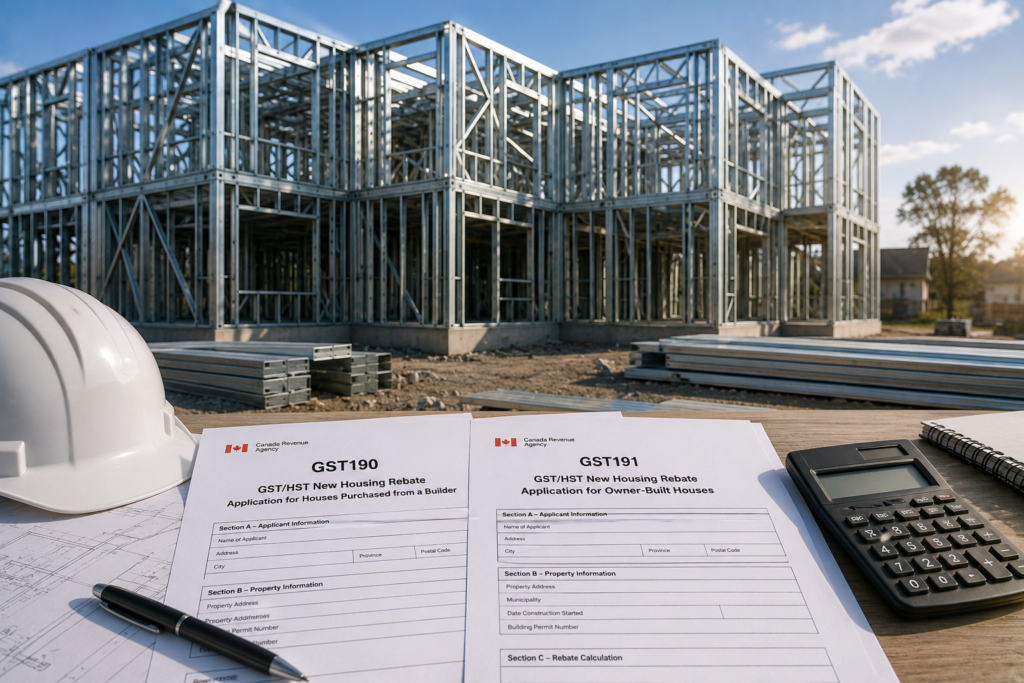
The CRA has published updated application forms for:
- Homes purchased from a builder (GST190)
- Owner-built homes and substantial renovations (GST191)
The revised forms explain how builders and purchasers can claim the enhanced provincial rebate while also allowing Ontario to process the separate Ontario New Home Affordability Payment.
For months, many builders were waiting for these forms before implementing the program with confidence. Their release provides a standardized process that can now be used across eligible projects.
Understanding the Ontario New Home Affordability Payment (ONHAP)
One of the most important aspects of the update is the clarification surrounding the Ontario New Home Affordability Payment.
Unlike the enhanced provincial rebate, the ONHAP is not administered through the builder’s GST/HST return.
Instead:
- The buyer completes the required consent section within the GST190 application.
- The CRA verifies eligibility and shares the necessary information with the Province of Ontario.
- Ontario processes the ONHAP payment separately.
Builders should also note that while the ONHAP can still be assigned to the builder through the purchase agreement, it is funded directly by the Province rather than claimed as a deduction on the builder’s GST/HST return.
Understanding this distinction helps avoid confusion during project closings and rebate administration.
How the Rebate Process Works
For a typical eligible transaction, the process follows three straightforward steps.
First, the buyer purchases a qualifying new home and completes the required CRA rebate application, authorizing the sharing of information with Ontario.
Next, the builder credits the buyer for the enhanced provincial rebate and the Ontario top-up at closing, reducing the amount the buyer pays when completing the purchase.
Finally, the builder submits the completed rebate documentation to the CRA, which processes the rebate, verifies eligibility, and provides the necessary information to Ontario so the separate affordability payment can be issued.
This coordinated process gives buyers immediate financial relief while ensuring builders have a clearly defined administrative pathway.
Why This Matters for Ontario Builders
Although the release of updated forms may seem like a procedural change, administrative certainty plays an important role in residential construction.
Builders benefit from:
- A standardized rebate process
- Greater confidence during home closings
- Fewer administrative uncertainties
- Improved communication with purchasers
When incentive programs are clearly defined, builders can better explain available savings to prospective buyers and incorporate those incentives into project planning.
This supports stronger buyer confidence and helps maintain momentum in Ontario’s housing market.
Better Affordability Supports New Housing
Housing affordability continues to be one of Ontario’s biggest challenges.
Government initiatives such as the enhanced GST/HST rebate are designed to reduce the financial burden on eligible homebuyers while encouraging new residential construction.
Lower effective purchase costs can improve demand for new homes, helping developers move projects forward with greater confidence.
Combined with recent initiatives such as development charge reductions in Toronto and investments in housing-enabling infrastructure, the province is creating a more supportive environment for residential development.
Efficient Construction Is Still Essential
Government incentives can improve affordability, but builders must still manage rising construction costs, labour shortages, and financing expenses.
That is why efficient construction methods remain just as important as financial incentives.
Light steel framing has become an increasingly popular choice for residential projects because it helps builders:
- Shorten construction schedules
- Improve dimensional accuracy
- Reduce material waste
- Minimize labour dependency
- Improve quality control through prefabrication
By completing projects more efficiently, builders can bring new homes to market sooner while making the most of available government incentives.
Looking Ahead
The release of the new CRA forms marks an important milestone in the implementation of Ontario’s enhanced housing rebate program.
Builders and buyers now have greater clarity regarding eligibility, documentation, and the claims process, making it easier to take advantage of the available financial relief.
As Ontario continues to address housing affordability and increase housing supply, administrative improvements like these help remove barriers that can delay new residential projects.
For developers, combining these government programs with efficient construction practices will remain one of the best strategies for delivering more homes while maintaining project profitability.
Practical Takeaway
The new CRA forms for the Ontario GST/HST New Housing Rebate provide the clarity that builders and buyers have been waiting for.
With the claims process now clearly established, eligible purchasers can access meaningful tax relief while builders gain greater certainty during project closings.
At the same time, government incentives alone cannot solve Ontario’s housing challenges. Faster, more efficient construction remains essential to delivering the homes the province needs.
By combining financial incentives with modern building methods such as prefabricated light steel framing, developers can improve project efficiency, reduce costs, and help bring new housing to market more quickly.
Work with LSF Pro Structures
At LSF Pro Structures, we help Ontario builders and developers deliver high-quality residential projects through precision-engineered light steel framing systems.
Our prefabricated cold-formed steel solutions reduce construction timelines, improve quality control, and support faster project delivery—helping builders maximize the benefits of today’s housing incentives while meeting tomorrow’s housing demand.
If you’re planning a residential development in Ontario, contact LSF Pro Structures to learn how light steel framing can improve your next project.