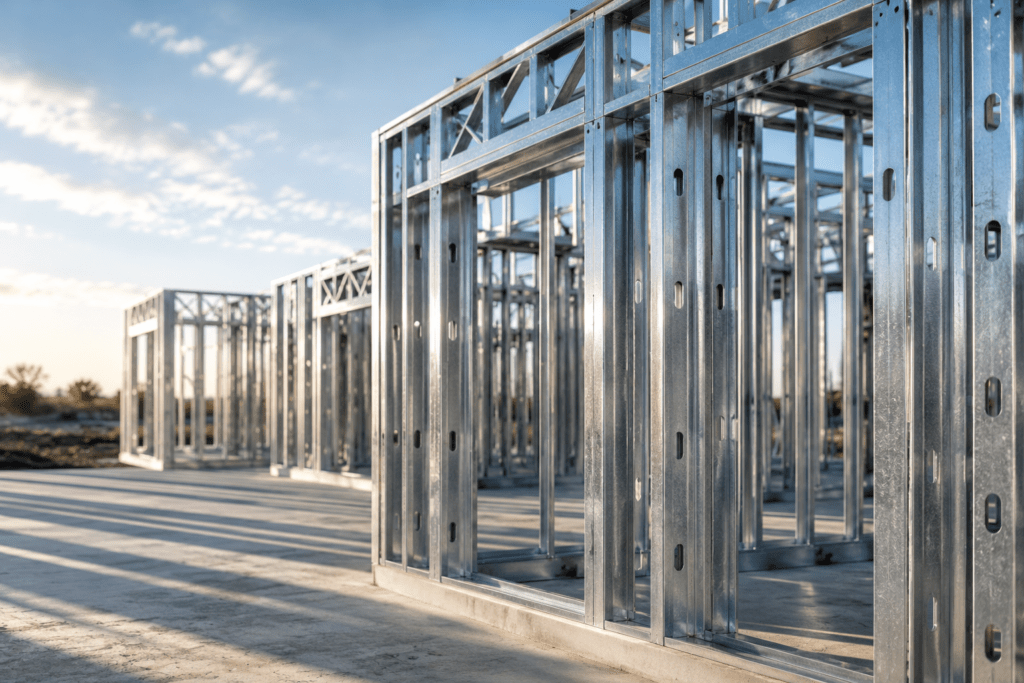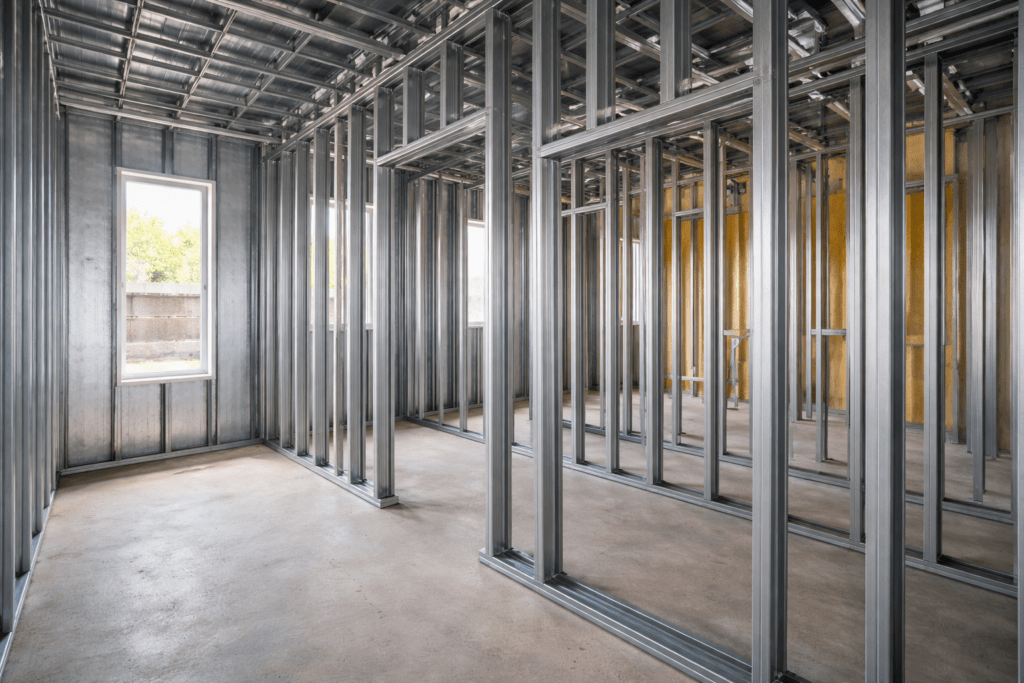
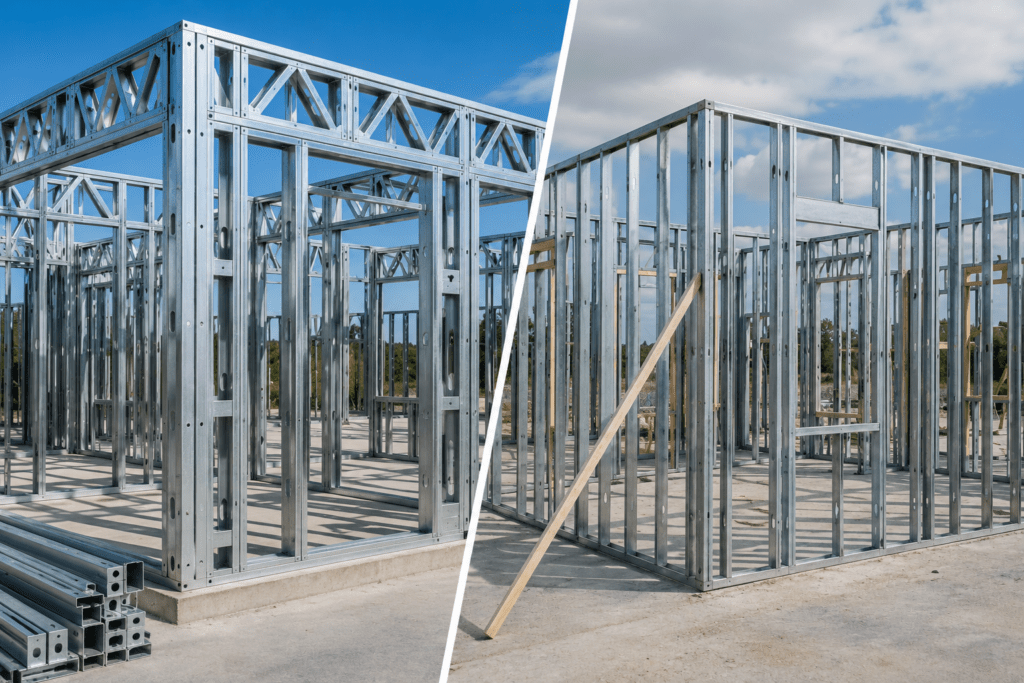
As light steel framing continues to grow across Ontario, developers are starting to recognize an important reality: not all LSF systems operate the same way.
One of the biggest distinctions in the market today is between FrameCAD-style light steel framing systems and traditional Canadian light steel framing methods.
At first glance, both use cold-formed steel. Both produce walls, floors, and structural framing systems. But the way these systems are designed, manufactured, and installed is fundamentally different.
For developers planning multi-unit housing, mid-rise buildings, or fast-track construction projects, understanding this difference is critical.
What Is Traditional Canadian Light Steel Framing?
Traditional Canadian light steel framing typically follows a site-built approach.
Studs and tracks are manufactured in standard sizes and shipped to the construction site in bundles. Crews then:
- Measure layouts on site
- Cut framing members manually
- Assemble walls piece by piece
- Coordinate adjustments during installation
This method is familiar to many contractors because it resembles traditional framing workflows.
It works reasonably well for:
- Smaller projects
- Simpler layouts
- Jobs requiring frequent field adjustments
However, it relies heavily on on-site labour, coordination, and installation consistency.
As project complexity increases, this becomes more difficult to manage efficiently.
What Is FrameCAD-Style Light Steel Framing?
FrameCAD-style systems follow a completely different philosophy.
Instead of treating framing as loose materials assembled in the field, the entire structure is engineered digitally before manufacturing begins.
The process typically includes:
- Full 3D structural modeling
- Direct machine-driven manufacturing
- Precision roll-forming from steel coil
- Automated service hole placement
- Pre-cut and labeled framing components
In many cases, wall panels and structural assemblies are manufactured before they arrive on site.
This transforms framing from a field-built process into a controlled manufacturing process.
That distinction changes everything.
The Real Difference: Material vs System
The most important difference is not the steel itself.
It is the approach.
Traditional Canadian LSF is primarily a material supply method. Builders receive framing components and create the structure on site.
FrameCAD-style framing is a system-based approach. The structure is digitally coordinated, engineered, manufactured, and prepared before installation begins.
This reduces variability and improves predictability throughout the project.
For developers, that translates directly into better schedule control and fewer site issues.
Construction Speed and Project Efficiency
One of the biggest advantages of FrameCAD-style systems is speed.
Because framing components are pre-engineered and often panelized, installation moves much faster. Crews spend less time measuring, cutting, and adjusting materials on site.
Instead, they assemble components that were already designed for exact fitment.
This creates major schedule advantages:
- Faster framing completion
- Earlier enclosure of the building
- Faster trade coordination
- Reduced weather exposure
In Ontario’s construction environment, where labour shortages and schedule pressure are growing concerns, these efficiencies matter significantly.
Precision and Build Quality
Precision is another area where the difference becomes obvious.
Traditional site-built framing depends heavily on crew accuracy. Even experienced installers can produce small inconsistencies during cutting and assembly.
Over large projects, these inconsistencies accumulate.
FrameCAD-style systems reduce this variability because components are machine-produced directly from digital design files.
That results in:
- More accurate framing layouts
- Better alignment
- Consistent service hole placement
- Improved drywall and finish quality
For multi-unit housing, where repetition and consistency are critical, this becomes a major advantage.
Reduced Dependence on Site Labour
Ontario’s construction industry continues to face labour challenges.
Traditional site-built framing requires significant on-site labour for measuring, cutting, assembly, and adjustments.
FrameCAD-style systems shift much of that work into controlled manufacturing environments.
This reduces:
- Labour dependency
- On-site congestion
- Installation variability
Projects become easier to schedule and manage because less depends on field improvisation.
That reduction in uncertainty is one reason more developers are moving toward advanced prefabricated systems.
Better Coordination Between Trades
Another major benefit of digitally engineered systems is coordination.
In traditional framing, conflicts between framing and mechanical systems are often discovered on site. This leads to field modifications, delays, and structural compromises.
FrameCAD-style systems allow service coordination earlier in the design process.
Because the framing is digitally modeled:
- Openings can be planned accurately
- Service routing can be coordinated in advance
- Structural conflicts can be resolved before manufacturing
This significantly reduces field modifications and installation problems.
Scalability for Multi-Unit Housing
The larger the project, the more valuable system-based framing becomes.
Multi-unit housing requires repetition, speed, and consistency. Traditional methods become harder to control as project scale increases.
FrameCAD-style systems are specifically well-suited for:
- Mid-rise residential buildings
- Apartment developments
- Modular and prefabricated construction
- Repetitive multi-unit layouts
Because the manufacturing process is standardized, quality and efficiency remain consistent across the project.
Why This Matters for Ontario Developers
Ontario’s construction market is changing quickly.
Developers are under pressure to:
- Build faster
- Reduce labour exposure
- Improve quality control
- Deliver projects more predictably
Traditional site-built framing methods can still work for smaller or less complex projects. But as timelines tighten and labour becomes harder to manage, advanced system-based framing offers clear advantages.
That is why FrameCAD-style systems are gaining more attention across Canada.
The Future of Light Steel Framing
The shift toward digitally engineered and manufactured framing systems is not just a trend.
It reflects a broader movement toward industrialized construction.
Developers increasingly want:
- Predictable schedules
- Controlled quality
- Reduced site risk
- Better scalability
FrameCAD-style light steel framing aligns directly with these goals.
The focus is no longer just on the material itself. It is on how efficiently the entire construction process operates.
Work with LSF Pro Structures
At LSF Pro Structures, we use advanced FrameCAD-style light steel framing systems to deliver precision-engineered solutions for projects across Ontario.
Our approach combines digital design, modern manufacturing, and prefabricated efficiency to help developers build faster and with greater consistency.
If you want to explore the advantages of FrameCAD-style light steel framing for your next project, contact LSF Pro Structures today.