Openings are some of the most critical areas in any light steel framing project. While most builders focus heavily on wall layouts and stud spacing, header design is often overlooked until problems begin to appear.
The reality is that header design in light steel framing plays a major role in structural performance, load transfer, and long-term durability. Improperly designed or installed headers can lead to excessive deflection, drywall cracking, door and window operation issues, and even structural deficiencies.
For builders and developers across Ontario, understanding how headers work and where mistakes commonly occur is essential for avoiding costly rework and inspection delays.
Why Headers Are Critical in Light Steel Framing
A header’s primary purpose is simple: it transfers loads around an opening.
When a door or window interrupts a wall, the loads that would normally travel through the missing studs must be redirected around the opening and safely transferred into adjacent framing members.
In light steel framing, this process must be carefully engineered because cold-formed steel members are designed to work as part of an integrated structural system.
A poorly designed header affects more than the opening itself. It can influence the performance of the entire wall.
How Loads Travel Around Openings
Every opening creates a disruption in the load path.
Without proper header design, loads from floors, roofs, or upper storeys cannot transfer efficiently to the foundation.
The header acts as a bridge across the opening, collecting loads from above and transferring them into jamb studs on each side.
If any component in this system is undersized or improperly installed, the load path becomes compromised.
This is why header design in light steel framing is not simply about spanning a gap. It is about maintaining structural continuity.
The Most Common Mistake: Assuming All Openings Are the Same
One of the most frequent errors on construction sites is using the same header detail for every opening.
Not all doors and windows carry the same loads.
A small residential window may require only minimal reinforcement, while a large opening beneath a floor system could carry significant structural loads.
The required header size depends on:
- Opening width
- Building height
- Loads above
- Stud configuration
- Span conditions
Assuming one standard detail works everywhere often leads to under-designed or over-designed framing.
Undersized Headers and Excessive Deflection
Perhaps the most common structural issue associated with openings is excessive deflection.
Even when a header appears strong enough, it may not be stiff enough.
Excessive deflection can lead to:
- Cracking around doors and windows
- Drywall damage
- Difficulty opening and closing doors
- Window performance issues
In many cases, the structure remains safe, but serviceability problems become noticeable to occupants.
These issues often appear months after construction is complete.
Inadequate Jamb Stud Design
A header is only as effective as the members supporting it.
Builders sometimes focus entirely on the header itself while overlooking the jamb studs beneath it.
These studs receive concentrated loads from the header and transfer them downward through the wall.
If jamb studs are:
- Undersized
- Improperly reinforced
- Poorly connected
the entire opening assembly becomes vulnerable.
Proper jamb design is just as important as header design.
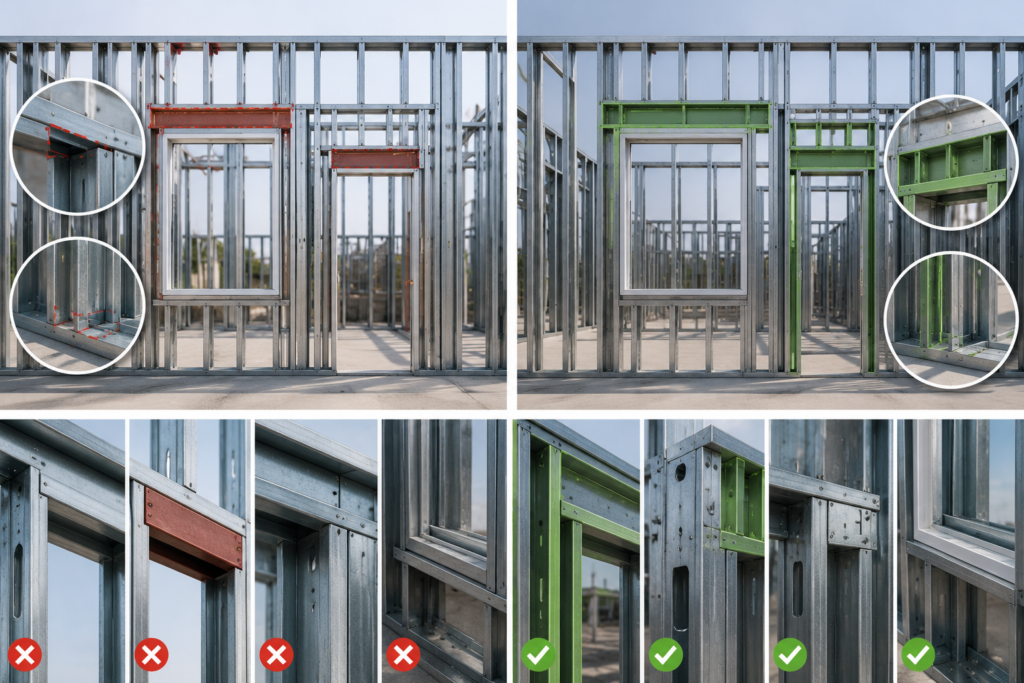
Poor Connection Details
Connections are another common source of problems.
Even a properly engineered header can underperform if the connections do not match the design.
Issues frequently occur when:
- Fastener spacing is incorrect
- Required screws are omitted
- Connection plates are modified
- Members are not fully seated
Because cold-formed steel relies heavily on connection performance, these seemingly minor mistakes can significantly affect load transfer.
This is one reason why header design in light steel framing must always be viewed as a complete assembly rather than an individual component.
Large Openings Require Special Attention
Modern architectural designs often feature larger windows and wider door openings.
These larger spans place greater demands on the framing system.
As openings increase in size, header design becomes more complex.
Engineers may use:
- Built-up headers
- Back-to-back sections
- Boxed assemblies
- Structural reinforcement strategies
Attempting to frame large openings using standard residential details is a common cause of structural deficiencies.
The Impact of Field Modifications
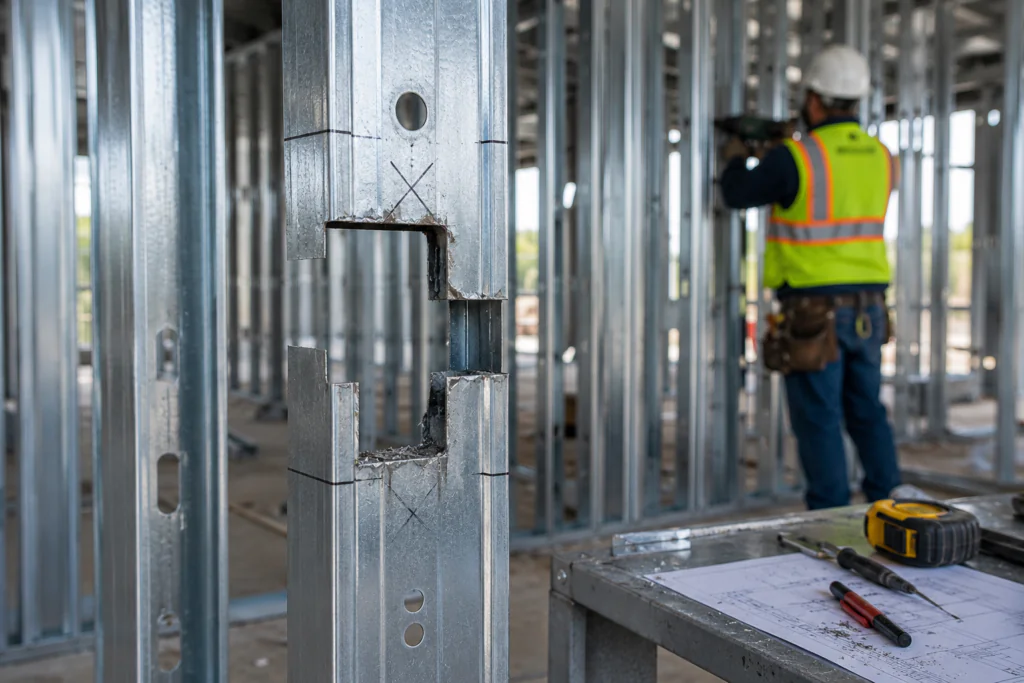
Field modifications frequently create problems around openings.
A header may be trimmed, relocated, or adjusted to accommodate other trades. While these changes may seem minor, they often affect the original engineering assumptions.
Because headers are load-carrying elements, any modification should be reviewed before implementation.
What appears to be a small adjustment can alter how forces move through the wall system.
Why Prefabrication Improves Header Accuracy
Prefabricated and panelized framing systems significantly reduce many of the errors associated with openings.
When panels are manufactured in controlled environments:
- Header sizes are verified
- Connection details are standardized
- Openings are coordinated with design documents
- Quality control is improved
This minimizes the likelihood of field improvisation and helps ensure that the installed framing matches the engineered design.
For Ontario projects facing labour shortages and schedule pressure, this consistency can be a major advantage.
Why Inspection Issues Often Start at Openings
Building inspectors pay close attention to door and window openings because they represent concentrated structural zones.
Incorrect header installation is one of the more common framing deficiencies identified during inspections.
When inspectors see:
- Missing reinforcement
- Improper connections
- Deviations from drawings
- Unapproved modifications
they often request corrections before approving the framing stage.
Proper planning and execution around openings can help avoid these delays.
The Long-Term Impact of Good Header Design
Well-designed headers do more than satisfy engineering requirements.
They contribute to:
- Better structural performance
- Improved finish quality
- Reduced maintenance issues
- Better occupant experience
When doors operate smoothly and walls remain crack-free years after construction, it is often because the structural details were executed properly from the beginning.
Practical Takeaway
Header design in light steel framing is one of the most important structural details around doors and windows.
Many problems that appear later in a project can be traced back to:
- Undersized headers
- Poor jamb design
- Inadequate connections
- Unapproved field modifications
Builders who pay close attention to these areas reduce risk, improve quality, and avoid costly corrections.
Work with LSF Pro Structures
At LSF Pro Structures, we provide engineered light steel framing systems designed for accurate load transfer and optimal performance around openings.
Our prefabricated solutions help ensure that headers, jambs, and connections are coordinated correctly from design through installation.
If you want to avoid common header design mistakes and improve the performance of your next project, contact LSF Pro Structures today.