Wall insulation plays a critical role in modern building performance. In cold climates like Canada, insulation determines how well a building retains heat during winter and maintains indoor comfort throughout the year.
Cold-formed steel framing systems support highly efficient insulation strategies when designed correctly. Builders can combine cavity insulation, continuous insulation, and air barrier systems to achieve strong thermal performance.
Because of these advantages, many developers now consider wall insulation design early in the steel framing process.
Why Wall Insulation Matters in Steel Framing
Insulation reduces heat transfer through building envelopes. Without proper insulation, buildings lose large amounts of energy through exterior walls.
In steel-framed structures, insulation becomes even more important. Steel conducts heat faster than many other materials. Therefore, builders must design insulation systems carefully to maintain energy efficiency.
However, when installed correctly, insulated steel wall systems can achieve excellent thermal performance.
As a result, cold-formed steel framing can meet strict energy codes across Canada.
Common Types of Wall Insulation Used With Steel Framing
Builders use several types of insulation in steel wall systems. Each option provides different thermal and acoustic benefits.
Batt Insulation
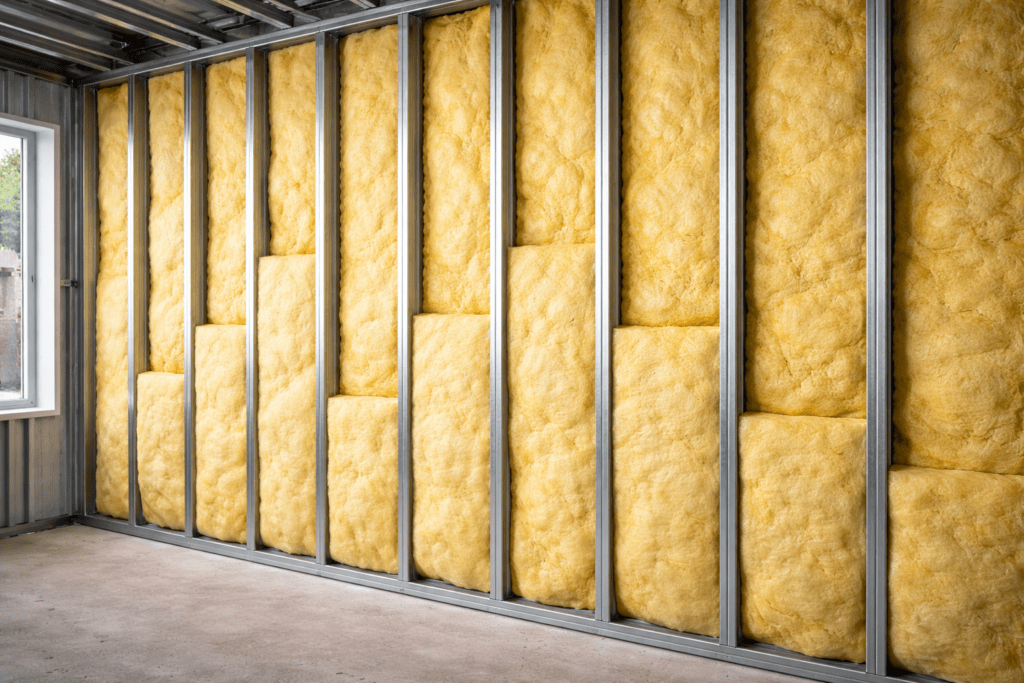
Batt insulation is one of the most common solutions for steel stud walls.
Contractors place fiberglass or mineral wool batts between the studs. This insulation fills the cavity and helps slow heat transfer through the wall.
Because batt insulation installs quickly, builders often use it in residential and multi-unit construction.
Mineral Wool Insulation
Mineral wool provides both thermal and fire resistance.
This insulation fits tightly between steel studs and resists moisture and mold. In addition, mineral wool improves sound control between rooms and units.
For multi-family buildings, mineral wool often becomes the preferred cavity insulation.
Spray Foam Insulation
Spray foam insulation expands after installation and fills small gaps in the wall system.
Because of this expansion, spray foam improves air sealing while providing strong thermal resistance.
However, builders typically use spray foam in specific areas rather than entire steel wall systems.
The Role of Continuous Insulation
Continuous insulation greatly improves wall insulation performance in steel buildings.
Steel studs can create thermal bridges that allow heat to escape. Continuous insulation solves this problem by adding a layer of insulation outside the structural framing.
Common continuous insulation materials include:
Rigid mineral wool boards
Polyisocyanurate insulation panels
Extruded polystyrene boards
This layer reduces heat loss and improves the overall R-value of the wall assembly.
As a result, buildings achieve better energy efficiency and lower heating costs.
Air Barriers and Vapor Control
Effective wall insulation requires proper air and vapor control.
Air barriers prevent uncontrolled air movement through the wall assembly. Without this protection, warm indoor air can carry moisture into the wall system.
In cold climates, vapor barriers typically appear on the warm interior side of the wall.
Together, these systems help maintain insulation performance while protecting the building structure from moisture damage.
When installed correctly, insulation, air barriers, and vapor control create a durable building envelope.
Acoustic Benefits of Insulated Steel Walls
Wall insulation improves more than just energy performance. It also enhances acoustic comfort inside buildings.
Insulated steel wall systems help reduce noise transfer between rooms and residential units.
For example, mineral wool insulation can significantly improve sound isolation in partition walls.
This benefit becomes especially valuable in apartment buildings, condos, and mixed-use developments.
Better sound control increases occupant comfort and building quality.
Best Practices for Insulating Steel Framed Walls
Builders can improve insulation performance by following several best practices.
First, they should install insulation tightly within the stud cavity. Gaps or compression can reduce thermal performance.
Second, they should include continuous exterior insulation whenever possible. This step reduces thermal bridging through steel studs.
Third, contractors should coordinate insulation with air barrier systems. Proper sealing prevents air leakage that reduces insulation effectiveness.
Finally, designers should select insulation materials that meet both thermal and fire safety requirements.
Following these practices ensures strong performance in steel framed buildings.
Energy Efficiency and Building Codes
Canadian building codes continue to raise energy efficiency requirements.
Because of this trend, proper wall insulation design becomes essential for compliance.
Steel framing systems can meet these standards when combined with high-performance insulation assemblies.
Many modern projects now incorporate:
High-R-value cavity insulation
Exterior continuous insulation
Advanced air barrier systems
Together, these elements create energy-efficient wall assemblies suitable for modern residential construction.
Final Thoughts
Wall insulation is a critical component of high-performance steel buildings. When designed correctly, insulated steel wall systems provide strong thermal performance, moisture protection, and acoustic comfort.
Cold-formed steel framing supports many insulation strategies, including cavity insulation and continuous exterior insulation.
Because of these advantages, builders can create durable, energy-efficient structures that perform well in demanding Canadian climates.
With the right insulation approach, steel framing systems deliver both structural strength and long-term building performance.