Cold formed steel load bearing capacity determines whether a structure performs safely under real-world conditions. It defines how much vertical and lateral load a steel-framed system can handle without failure. For developers, engineers, and builders in Canada, this is not theoretical. It directly impacts building height, stud spacing, floor design, and code compliance.
In this guide, we break down how load-bearing capacity works in cold-formed steel framing and what influences structural performance in multi-unit and mid-rise projects.
What Cold Formed Steel Load Bearing Capacity Actually Means
Cold formed steel load bearing capacity refers to the maximum load a steel stud or structural member can safely support before experiencing buckling, yielding, or structural instability.
In practical construction terms, this includes:
Axial loads from floors and roofs
Live loads from occupants and furniture
Dead loads from cladding and finishes
Lateral loads from wind
Concentrated loads at openings
Unlike wood framing, cold formed steel provides consistent, engineered performance. Each member is manufactured to precise gauge thickness and profile dimensions. That consistency allows engineers to calculate capacity accurately instead of estimating variability.
Load capacity depends on engineering calculations, not assumptions.
Key Factors That Influence Load Bearing Capacity
Cold formed steel load bearing capacity does not rely on one variable. Multiple design factors work together.
1. Steel Gauge Thickness
Gauge directly affects strength.
Thicker steel increases:
Axial compression capacity
Resistance to local buckling
Overall structural stiffness
For example, a 20 gauge stud can support significantly more load than a 25 gauge stud of the same depth and spacing. However, increasing gauge also increases cost and weight. Engineers must balance structural demand with material efficiency.
2. Stud Depth and Section Profile
Stud depth changes structural performance.
Deeper studs:
Increase moment of inertia
Improve resistance to bending
Reduce deflection under load
A 6-inch stud performs differently than a 3 5/8-inch stud under the same load conditions. Profile geometry, including flange width and lip size, also impacts buckling resistance.
The shape matters as much as thickness.
3. Stud Spacing
Stud spacing directly influences wall load capacity.
Common spacing includes:
12 inches on center
16 inches on center
24 inches on center
Tighter spacing distributes loads across more members. This increases total wall capacity and reduces individual stud stress. Wider spacing lowers material cost but reduces structural redundancy.
Engineers determine spacing based on floor loads, building height, and code requirements.
4. Unbraced Length and Lateral Support
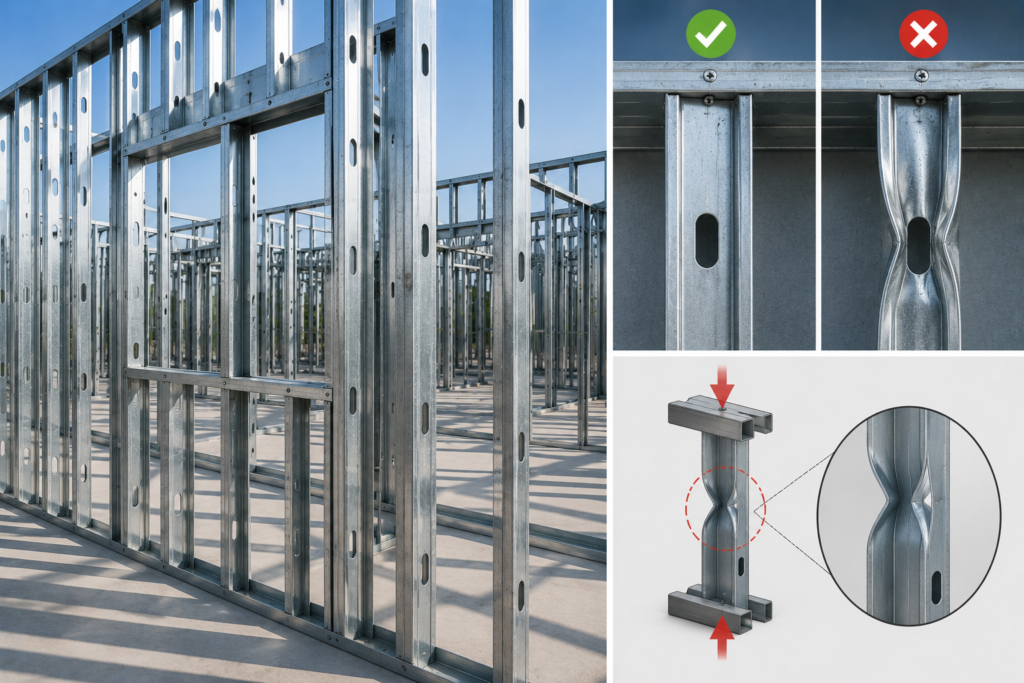
Cold formed steel members buckle when unsupported over long spans.
Reducing unbraced length increases load bearing capacity. Bracing methods include:
Sheathing attachment
Bridging channels
Blocking
Track anchorage
Proper bracing allows thinner gauges to perform at higher capacities. Poor bracing design can reduce structural performance significantly.
Bracing is not optional. It is structural.
Axial Load vs Lateral Load Considerations
When evaluating cold formed steel load bearing capacity, engineers must separate axial and lateral performance.
Axial Loads
Axial loads act vertically through studs. These loads come from:
Floor systems
Roof systems
Stacked walls
Axial capacity depends on:
Slenderness ratio
Steel yield strength
Effective length
Section modulus
As building height increases, axial demand increases. Multi-storey buildings require precise structural modeling.
Lateral Loads
Wind loads impact mid-rise and low-rise Canadian projects heavily.
Cold formed steel performs well under lateral loads because:
Steel resists warping
Connections can be engineered
Sheathing creates diaphragm action
In Ontario and other high-wind zones, lateral design becomes a critical performance factor.
Canadian Building Code Considerations
In Canada, structural design must align with:
National Building Code of Canada requirements
CSA standards for steel construction
Local wind and snow load data
Snow loads in Ontario significantly affect roof framing. Cold formed steel load bearing capacity calculations must include snow accumulation factors.
Engineers use design software and structural tables to confirm compliance before fabrication begins.
Manufacturers fabricate to approved engineered shop drawings. Fabrication does not replace structural design.
Floor Systems and Load Transfer
Wall load bearing capacity works together with floor systems.
Cold formed steel buildings commonly use:
Steel joists
Composite deck systems
Panelized floor assemblies
Load transfers from floor joists into load bearing walls, then down into foundations. Proper connection detailing ensures that axial loads distribute evenly.
Ignoring load paths creates structural risk.
Professional design accounts for:
Point loads at stair openings
Mechanical shaft penetrations
Balcony loads
Corridor spans
In mid-rise residential projects, corridor walls often carry major vertical loads.
Comparing Cold Formed Steel to Wood Framing Capacity
When comparing cold formed steel load bearing capacity to wood:
Cold formed steel offers:
Predictable structural values
No shrinkage
No warping
No moisture-related strength loss
Wood varies by grade, moisture content, and knots. Steel does not.
For developers building multi-unit residential or mixed-use buildings, predictability reduces engineering risk and improves inspection outcomes.
Design Responsibility vs Manufacturing Responsibility
Understanding load bearing capacity also clarifies responsibility.
Structural engineers:
Calculate required capacity
Specify gauge and spacing
Approve shop drawings
Manufacturers:
Fabricate to approved specifications
Ensure dimensional accuracy
Maintain material consistency
Engineering determines safety. Manufacturing ensures execution.
Why Load Bearing Capacity Matters for Developers
For developers and general contractors, cold formed steel load bearing capacity affects:
Maximum building height
Unit stacking potential
Open floor plan flexibility
Structural cost optimization
Inspection approval timelines
Choosing the correct structural system early reduces redesign delays later.
Engineering-driven steel framing supports:
Mid-rise residential
Modular construction
Mixed-use developments
Institutional buildings
Capacity is not just structural. It is strategic.
Final Thoughts on Cold Formed Steel Load Bearing Capacity
Cold formed steel load bearing capacity defines how safely and efficiently a structure performs. It depends on gauge thickness, stud depth, spacing, bracing, and engineered design calculations.
For Canadian projects, proper structural modeling ensures compliance with building code requirements while optimizing material use.
If you want structural performance with precision, predictability, and scalability, cold formed steel framing provides a clear advantage.