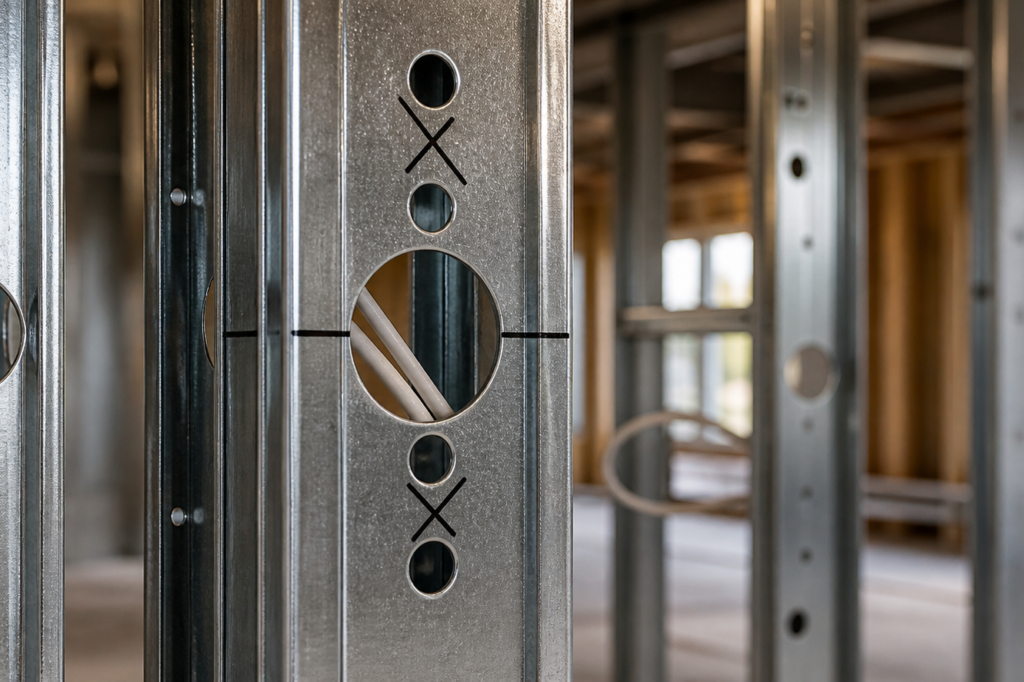
In light steel framing, service holes are often treated as a routine detail. Electrical, plumbing, and mechanical systems need pathways, and studs come pre-punched or are modified on site to accommodate them.
But here is the problem: service hole placement in steel studs is not just a convenience feature. It has a direct impact on structural performance.
Many builders underestimate this. Some even modify studs in the field without understanding the consequences. In multi-unit housing and engineered projects across Ontario, that can lead to serious issues ranging from reduced load capacity to failed inspections.
This guide breaks down what actually matters and how to avoid costly mistakes.
Why Service Holes Exist in Steel Studs
Service holes are designed to allow utilities to pass through framing without requiring additional framing depth or complicated routing.
In modern construction, efficient coordination between structure and services is essential. Pre-punched holes in cold-formed steel studs help streamline installation and reduce on-site work.
However, these openings remove material from the web of the stud. That is where the structural concern begins.
The Structural Role of the Stud Web
To understand the impact of service holes, you need to understand how a steel stud works.
The web of the stud carries shear forces and contributes to the overall stability of the member. It plays a critical role in resisting:
- Axial loads
- Shear forces
- Local buckling
When a hole is introduced into the web, it reduces the effective cross-sectional area.
That reduction can weaken the stud, especially if the hole is:
- Too large
- Too close to critical stress zones
- Improperly spaced
This is why service hole placement in steel studs must be controlled, not improvised.
Pre-Punched Holes vs Field Modifications
There is a major difference between factory-punched holes and holes created on site.
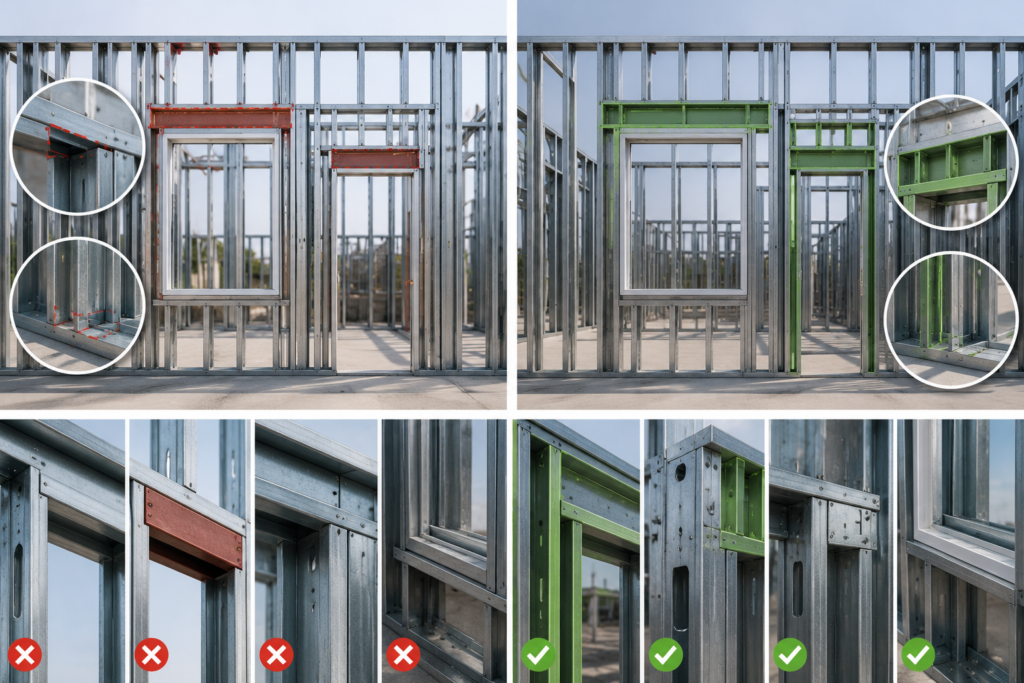
Pre-punched holes are:
- Engineered as part of the stud design
- Located in positions that minimize structural impact
- Sized according to manufacturer specifications
Field-cut holes are often:
- Inconsistent in size and location
- Made without structural verification
- Placed based on convenience rather than engineering
This is where many problems start.
Cutting or enlarging holes on site without approval can significantly reduce the load capacity of the stud.
In some cases, it can compromise the entire wall system.
Critical Factors That Affect Structural Impact
Not all service holes are equal. Their impact depends on several key factors.
The size of the hole is the most obvious one. Larger holes remove more material and create greater stress concentrations.
Location is just as important. Holes placed near high-stress regions, such as mid-height of load-bearing studs or near supports, can have a much greater impact than those in lower-stress zones.
Spacing between holes also matters. Multiple holes placed too close together can weaken the stud significantly more than a single opening.
Stud thickness and gauge play a role as well. Thinner studs are more sensitive to material removal.
These factors work together. Ignoring any one of them can lead to problems.
What CSA Standards and Engineering Require
In Canada, cold-formed steel design is governed by CSA S136.
This standard considers the effects of holes in structural members and provides guidance on how to account for them in design.
Engineers typically:
- Factor hole size and location into load calculations
- Specify allowable configurations
- Restrict field modifications
If a stud is designed with pre-punched holes, those holes are already accounted for.
If additional modifications are made, the original design assumptions may no longer be valid.
That is when risk is introduced.
Common Mistakes Builders Make
One of the most common mistakes is enlarging service holes on site to accommodate larger pipes or ducts.
Another is cutting new holes where none were originally provided.
These changes are often made quickly, without considering structural implications.
In many cases, the issue is not immediately visible. The wall may look fine, but its load capacity has been reduced.
Over time, this can lead to:
- Excessive deflection
- Cracking in finishes
- Inspection failures
- Structural concerns
These problems are preventable with proper planning.
How to Handle Services Without Compromising Structure
The key is coordination.
Service routing should be considered during design, not during installation. When framing and building systems are coordinated early, service holes can be properly located and sized without compromising performance.
Using pre-engineered studs with correctly placed service holes is the safest approach.
If changes are required, they should be reviewed by an engineer before being implemented.
That small step can prevent major issues later.
Why This Matters More in Multi-Unit Projects
In multi-unit housing, the impact of small mistakes multiplies.
A single poorly placed service hole may not seem critical, but repeated across dozens or hundreds of units, it can create systemic issues.
Consistency is key in these projects.
Light steel framing is often chosen for its precision and repeatability. Improper modifications undermine those advantages.
That is why service hole placement in steel studs becomes even more important at scale.
The Bigger Picture: Performance and Reliability
This topic is not just about holes in steel.
It is about maintaining the integrity of an engineered system.
Light steel framing works best when it is treated as a complete system, not a collection of individual components.
Every modification affects performance.
Builders who understand this approach deliver more reliable projects with fewer surprises.
Practical Takeaway
Service holes are necessary, but they must be controlled.
Using pre-punched, engineered openings and avoiding unapproved field modifications is critical.
When in doubt, involve engineering.
The cost of getting it wrong is far greater than the effort required to do it right.
Work with LSF Pro Structures
At LSF Pro Structures, we provide engineered light steel framing systems with properly designed service hole configurations to ensure structural performance and ease of installation.
We help developers and builders coordinate framing and services from the start, reducing risk and improving efficiency.
If you want to ensure your project avoids common service hole mistakes and performs as designed, contact LSF Pro Structures today.