In light steel framing, structural performance depends on one fundamental principle: load path design in light steel framing.
If the load path is clear and continuous, the structure performs as expected. If it is disrupted, even slightly, problems begin to appear.
Many builders focus on member size, thickness, or spacing. But in reality, most structural issues in cold-formed steel systems come from something much simpler: loads not being transferred correctly from one element to another.
This is where small mistakes create big consequences.
What Is a Load Path in Light Steel Framing?
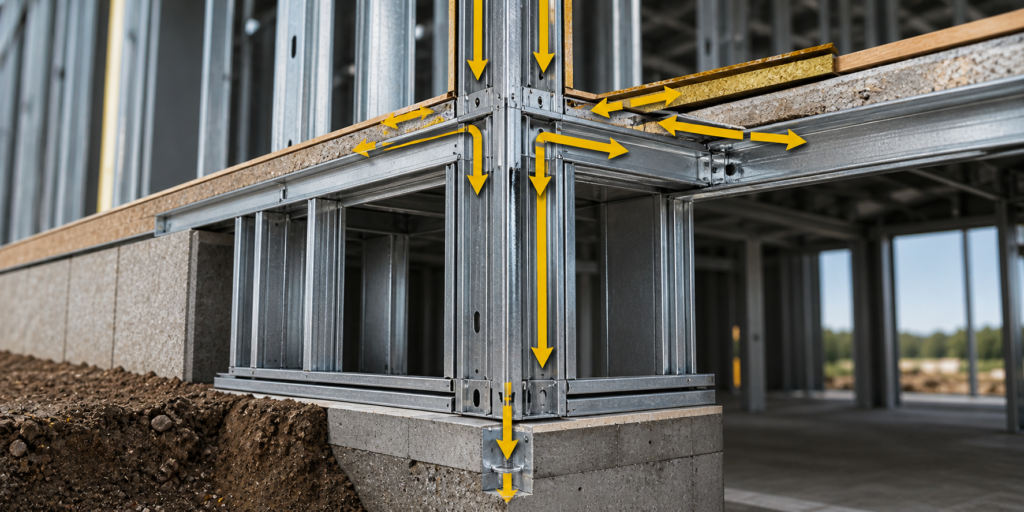
A load path is the route that forces follow as they travel through a structure.
Loads start at the top of the building and move downward through:
- Roof or floor systems
- Wall studs
- Tracks and connections
- Foundations
Every element in this chain must align properly for the system to work.
In light steel framing, this alignment is critical because members are thin and rely heavily on connections and continuity.
If one part of the load path is interrupted, the entire system is affected.
Why Load Path Design Matters More in CFS
Cold-formed steel systems behave differently from heavier structural systems.
Because the members are lighter and more precise, they depend on:
- Proper alignment
- Accurate connections
- Continuous load transfer
There is less tolerance for error.
In traditional systems, some redundancy may absorb small mistakes. In light steel framing, small misalignments can quickly lead to performance issues.
That is why load path design in light steel framing must be approached with precision.
Where Load Path Problems Begin
Most related issues do not come from design. They come from execution.
On drawings, load paths are typically clear. Studs align with joists, loads transfer through tracks, and connections are properly detailed.
On site, conditions change.
A stud may be slightly offset. A connection may be adjusted. A component may be modified to accommodate another trade.
These changes can break the intended load path.
Once that happens, loads are forced to find alternative routes through the structure. These routes are not always designed to carry them.
Misalignment Between Structural Elements
One of the most common issues is misalignment.
For a proper load path, vertical loads should transfer directly from one member to another.
If a stud does not align with the load above, the force must shift sideways before moving downward. This creates additional stress in connections and surrounding members.
Over time, this can lead to:
- Localized deformation
- Increased deflection
- Cracking in finishes
In multi-unit buildings, repeated misalignment can affect entire sections of the structure.
Connection Disruptions
Connections are a key part of the load path.
Even if members are aligned, poor connections can interrupt load transfer.
Missing fasteners, incorrect spacing, or improper installation can weaken connections and reduce their ability to carry loads.
In light steel framing, where loads are distributed across many connections, even small deficiencies can have a cumulative effect.
This is why connection quality is directly tied to load path performance.
Impact of Field Modifications
Field modifications are another major risk.
Changes made during construction to accommodate services or resolve coordination issues can alter the load path.
Cutting members, relocating studs, or adjusting connections may solve immediate problems but create structural issues.
These modifications are often done without considering how loads will be redistributed.
That is when small changes become big problems.
Concentrated Loads and Overstressed Areas
When a load path is disrupted, loads do not disappear. They shift.
This can create concentrated forces in areas that were not designed to handle them.
These overstressed zones may not fail immediately. Instead, they show signs over time, such as:
- Excessive movement
- Cracking
- Reduced structural performance
In some cases, these issues only become visible after finishes are installed, making them more difficult and expensive to fix.
Why Precision Matters in Multi-Unit Projects
In multi-unit housing, repetition amplifies both good and bad practices.
If load paths are properly aligned, the system performs consistently across all units.
If mistakes are repeated, the impact multiplies.
This is why precision in layout, alignment, and installation is essential for larger projects.
Light steel framing is designed for repeatability. Maintaining that consistency is key to its performance.
How Prefabrication Improves Load Path Accuracy
Prefabrication is one of the most effective ways to maintain proper load paths.
When components are manufactured off-site:
- Alignment is controlled
- Connections are standardized
- Variability is reduced
This ensures that the load path designed by engineers is maintained during construction.
For projects in Ontario, where labour variability and schedule pressure can affect quality, prefabrication provides a more reliable approach.
The Real Cost of Small Mistakes
Load path issues rarely cause immediate failure.
Instead, they lead to performance problems that appear over time.
These can include:
- Cracking in drywall
- Uneven floors
- Structural movement
- Inspection failures
The cost of fixing these issues is often much higher than preventing them.
That is why attention to load path design and execution is so important.
Why This Matters in Canadian Construction
Canada’s building environment places additional demands on structures.
Temperature changes, moisture, and long-term use all affect how loads are carried and distributed.
A well-designed and properly executed load path ensures that the structure performs reliably under these conditions.
Builders who understand this deliver stronger, more durable buildings.
Practical Takeaway
Load path design in light steel framing is not just an engineering concept. It is a construction reality.
Every stud, track, and connection plays a role in transferring loads.
Maintaining alignment between design and execution is essential. This means:
- Keeping members properly aligned
- Following connection details exactly
- Avoiding unapproved modifications
Small mistakes in these areas can create large structural issues.
Work with LSF Pro Structures
At LSF Pro Structures, we provide engineered light steel framing systems designed to maintain clear and continuous load paths from design through installation.
Our approach reduces risk, improves accuracy, and ensures your project performs as intended.
If you want to avoid common load path issues and build with confidence, contact LSF Pro Structures today.