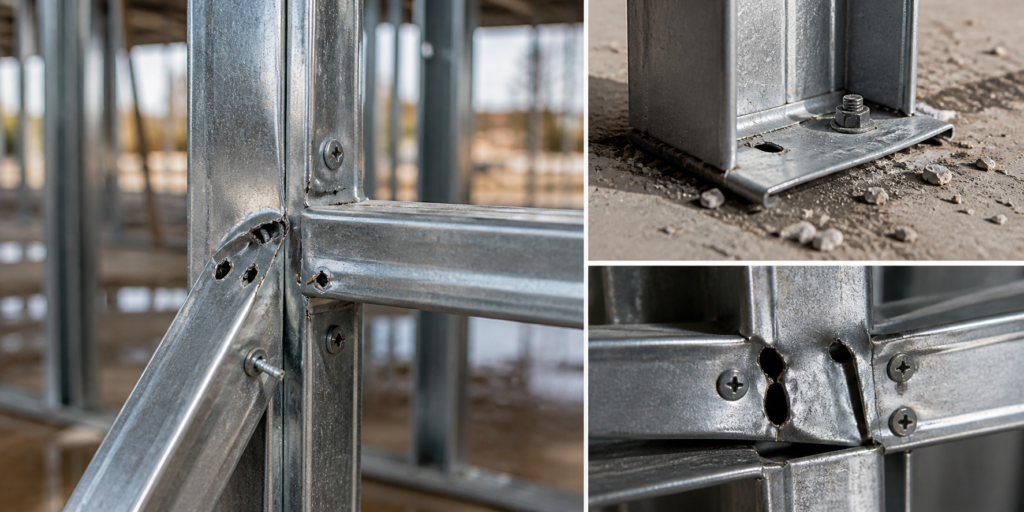
In light steel framing, most structural problems do not start with the studs. They start with the connections.
That is why cold-formed steel connection failures are one of the most underestimated risks in Canadian construction. On drawings, everything looks precise and engineered. But once construction begins, small gaps between design intent and site execution can create real issues.
For builders and developers in Ontario, understanding where these failures come from is critical to avoiding delays, rework, and long-term performance problems.
Why Connections Control the System
Cold-formed steel framing works as a system, not as individual members acting alone. The studs, tracks, and other components rely on connections to transfer loads and maintain structural continuity.
These connections carry axial forces, shear, and lateral loads throughout the structure. If they do not perform as intended, the load path is disrupted. When that happens, even perfectly designed members cannot compensate.
This is why connection performance often matters more than member strength in cold-formed steel systems.
The Disconnect Between Design and Site Conditions
Engineering drawings assume ideal conditions. They assume that the correct fasteners are used, that spacing is consistent, and that all components are aligned exactly as designed.
On site, conditions are rarely perfect.
Construction schedules are tight. Labour varies in experience. Coordination between trades is not always seamless. As a result, small changes happen during installation. A screw might be missed, spacing might be slightly off, or a connection might be adjusted to accommodate another trade.
Individually, these changes may seem minor. But in cold-formed steel, they can alter how loads are transferred through the system.
This gap between design assumptions and real-world installation is where most cold-formed steel connection failures originate.
Fasteners: The Most Common Failure Point
One of the most frequent issues in the field is related to fasteners.
Cold-formed steel connections depend heavily on screws. The type, size, and installation quality of these screws directly affect connection strength.
Problems often occur when incorrect screws are used, or when installation is not done properly. Overdriven screws can damage the steel and reduce holding capacity. Underdriven screws can leave the connection loose.
Even small inconsistencies in spacing can affect how loads are distributed across a connection. When this happens repeatedly across a project, it creates weak points throughout the structure.
Alignment and Fit-Up Issues
Another common source of failure is poor alignment.
Connections are designed with the assumption that members fit together properly. When studs, tracks, or panels are not aligned correctly, connections may not engage fully.
This can lead to uneven load transfer or localized stress concentrations. Over time, this may result in deflection, movement, or cracking in finishes.
In multi-unit projects, where the same details are repeated many times, these small issues can become widespread.
Load Path Disruption
Every structure depends on a continuous load path from the top of the building to the foundation.
Connections define that path.
When connections are missing, modified, or improperly installed, the intended load path is interrupted. Loads may be redirected in ways that were not accounted for in the design.
This can lead to unexpected stresses in certain areas, while other parts of the system carry less load than intended. Over time, this imbalance affects structural performance and durability.
Impact of Field Modifications
Field modifications are another major contributor to cold-formed steel connection failures.
Changes are often made on site to accommodate mechanical or electrical systems, or to resolve coordination issues. These may include relocating connections, cutting members, or adjusting fastener patterns.
While these changes may solve immediate installation challenges, they can compromise the structural design if not properly reviewed.
Cold-formed steel systems are sensitive to changes because they rely on precise geometry and load distribution. Even small modifications can alter performance.
Why Prefabrication Reduces Risk
One of the most effective ways to minimize connection issues is to reduce variability.
Prefabricated light steel framing systems achieve this by shifting much of the work from the job site to a controlled manufacturing environment.
In these systems, connections are designed, positioned, and often partially assembled before delivery. This ensures consistency and reduces reliance on field decisions.
For developers in Ontario, where labour variability and schedule pressure are real challenges, prefabrication offers a more predictable outcome.
Inspection and Quality Control
Because connection issues are not always obvious, inspection plays a key role.
A connection may appear complete but still be missing fasteners or installed incorrectly. Without proper inspection, these issues can go unnoticed until later stages of construction or even after occupancy.
Regular checks during installation help ensure that connections match the design intent. Early detection of problems reduces the need for costly corrections later.
The Real Cost of Getting It Wrong
Cold-formed steel connection failures rarely cause immediate collapse. Instead, they lead to gradual performance issues.
These can include excessive deflection, cracking in drywall, or movement in the structure. In some cases, they result in failed inspections and project delays.
The financial impact comes from rework, schedule disruption, and reduced building quality.
Avoiding these problems requires attention to detail and a clear understanding of how connections function within the system.
Why This Matters in Canada
Canadian construction places high demands on structural systems. Temperature changes, building movement, and long-term durability all depend on connections performing as intended.
Cold-formed steel is an efficient and reliable system when installed correctly. But it requires discipline in execution.
Builders who understand the importance of connection quality deliver better results and avoid common pitfalls.
Practical Takeaway
Connections are not a minor detail in cold-formed steel framing. They are central to how the system works.
Maintaining alignment between design and installation is essential. This means using the correct fasteners, following specified spacing, and avoiding unapproved changes.
Projects that respect these principles perform as intended. Those that do not often face avoidable issues.
Work with LSF Pro Structures
At LSF Pro Structures, we provide engineered light steel framing systems designed with connection performance in mind.
Our approach ensures that what is designed is what gets built, reducing risk and improving reliability on site.
If you want to avoid common cold-formed steel connection failures and deliver a higher-quality project, contact LSF Pro Structures today.