As architectural demands continue to evolve, flexibility in structural systems has become a major design priority. This is one reason design flexibility in light steel framing is gaining attention across Canada.
Architects today are being asked to do more with less. More density on tighter sites. More design creativity under stricter budgets. More performance under tighter timelines.
Cold-formed steel, or CFS, is helping make that possible.
Far beyond a framing material, it has become a design tool that allows architects and developers to solve problems more efficiently while expanding what is possible in modern construction.
Why Design Flexibility Matters More Than Ever
In Ontario’s construction market, projects face growing complexity. Urban infill sites are tighter. Municipal requirements are stricter. Clients want faster delivery without sacrificing aesthetics or performance.
Traditional systems can limit design freedom because they often force the architecture to adapt to the material.
With light steel framing, the opposite often happens.
The framing system can adapt to the architecture.
That shift changes everything.
What Creates Design Flexibility in Light Steel Framing
The flexibility of cold-formed steel comes from its combination of precision, strength, and manufacturability.
Because components are engineered and roll-formed to exact dimensions, architects can work with highly customized framing layouts while maintaining structural consistency.
Unlike traditional framing methods that rely on standard field-built approaches, light steel framing supports tailored solutions without introducing major complexity.
That is what makes design flexibility in light steel framing such a significant advantage.
Freedom to Create More Complex Geometry
One of the biggest advantages of CFS is its ability to support more sophisticated architectural forms.
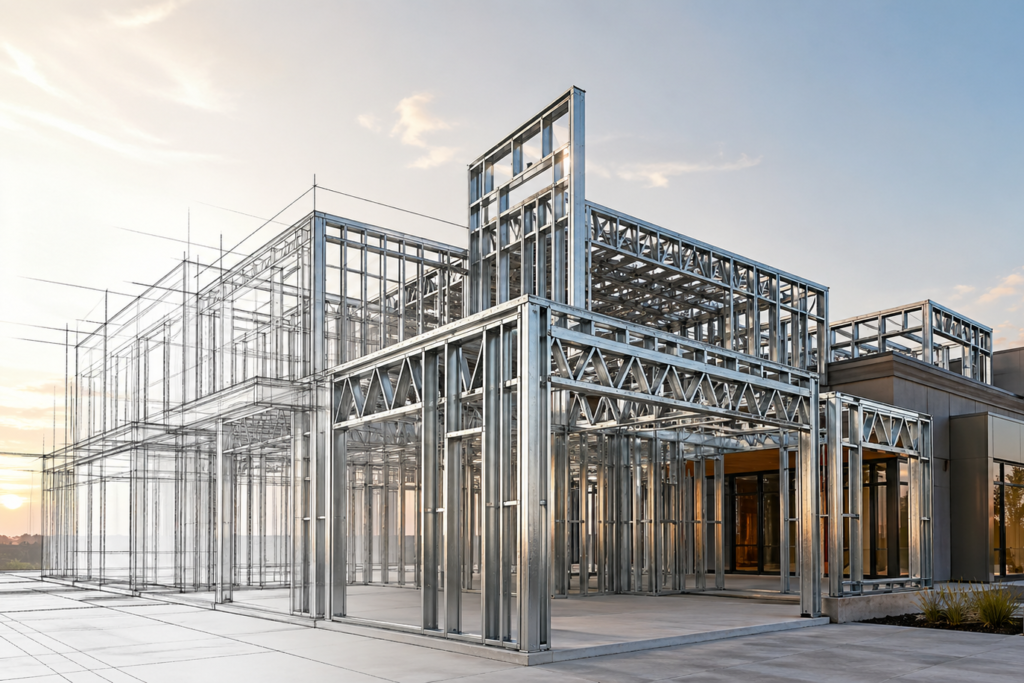
Curved walls, stepped facades, cantilevers, varied rooflines, and custom exterior forms can often be executed more efficiently with light steel framing than many conventional systems.
Because members can be manufactured precisely for project-specific geometry, architects have far more freedom to design without forcing expensive structural compromises later.
For projects where aesthetics matter, this becomes a major benefit.
More Efficient Use of Space
In multi-unit housing, usable floor area is critical.
Light steel framing often allows thinner wall assemblies than bulkier structural systems, which can increase net usable area within the same building envelope.
That can translate into:
- More rentable space
- Better unit layouts
- Improved project economics
For architects balancing density and livability, this flexibility has direct value.
In many cases, design flexibility is not just about form. It is about making space work harder.
Better Integration with Modern Building Systems
Modern buildings are increasingly complex, with mechanical, electrical, and plumbing systems competing for space.
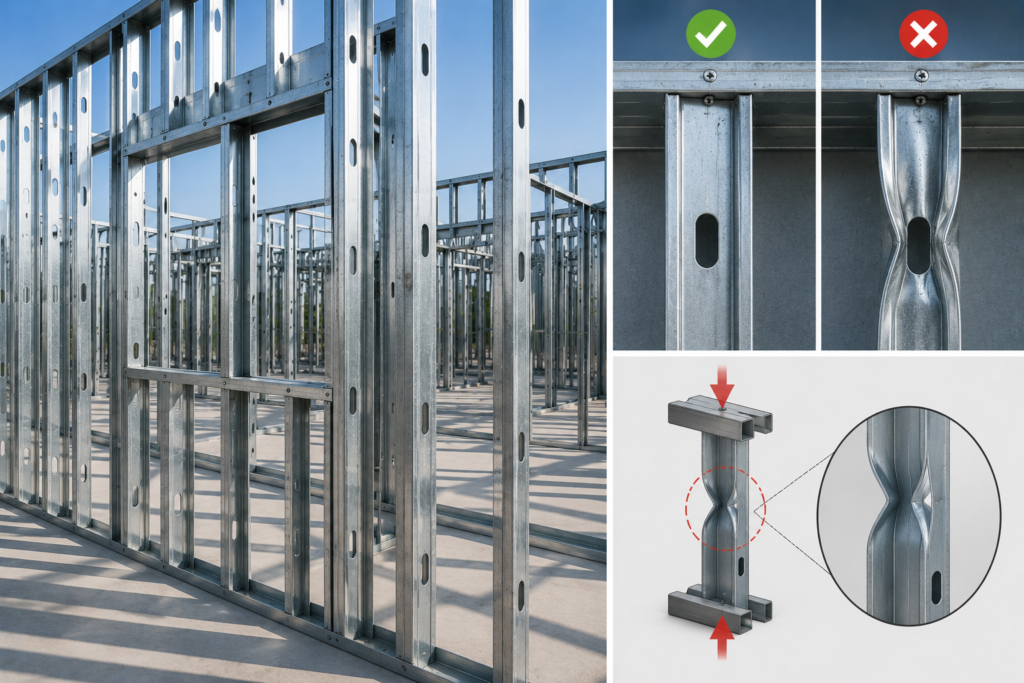
CFS systems often incorporate service holes and coordinated framing layouts that make integration much easier.
This improves coordination between architecture and building systems while reducing conflicts during construction.
Instead of forcing building services to adapt later, the framing can be designed with those systems in mind from the beginning.
That is another major reason design flexibility in light steel framing continues to attract attention.
Supporting Prefabrication and Modular Design
Flexibility does not only apply to form. It also applies to how projects are delivered.
Because light steel framing works exceptionally well with prefabrication and panelization, architects can design for modular construction strategies without sacrificing customization.
This creates a powerful combination:
Creative design with industrial efficiency.
For Ontario projects facing labour shortages and schedule pressure, that combination is becoming increasingly valuable.
Adapting to Tight Urban Sites
Urban infill development often requires creative structural solutions.
Irregular lots, setbacks, existing conditions, and zoning constraints can make conventional framing systems difficult to optimize.
Light steel framing offers a level of adaptability that helps architects respond to these challenges more efficiently.
Whether designing over existing structures, maximizing density on constrained sites, or working through complicated municipal requirements, flexible framing systems can unlock options that may otherwise be difficult to achieve.
Structural Efficiency Without Overbuilding
A common misconception is that greater flexibility means greater complexity.
With CFS, flexibility often comes with efficiency.
Because members can be engineered specifically for project loads and conditions, systems can be optimized rather than overbuilt.
This can reduce material usage while still meeting structural performance requirements.
For developers, that can improve both cost control and design outcomes.
Why Architects Are Paying More Attention to CFS
Architects are increasingly drawn to systems that support both creativity and practical execution.
Light steel framing does both.
It offers:
- Greater geometric freedom
- Better coordination with building systems
- Efficient use of space
- Compatibility with prefabrication
- High-performance structural solutions
That combination is difficult to ignore.
As project demands become more complex, materials that expand possibilities rather than constrain them naturally become more valuable.
Common Mistake Developers Make
Some developers still treat framing as something chosen after the architecture is complete.
That often limits the potential of the project.
When light steel framing is integrated early, architects can use its flexibility intentionally rather than simply fitting it in later.
That is where the biggest gains happen.
The most efficient projects are often the ones where architecture and structural strategy are developed together from the start.
Why This Matters in Canada
Canadian construction is moving toward faster delivery, higher performance, and smarter use of space.
Design flexibility in light steel framing aligns directly with those priorities.
It allows projects to be more efficient without becoming generic.
It allows architects to be creative without sacrificing practicality.
And it allows developers to deliver buildings that perform both structurally and commercially.
That is why CFS is becoming a more strategic choice across Ontario and beyond.
Work with LSF Pro Structures
At LSF Pro Structures, we help architects and developers unlock the full potential of light steel framing through advanced design, engineering, and prefabricated solutions.
Whether your project involves multi-unit housing, urban infill, or custom architectural applications, we can help you build with greater flexibility and efficiency.
Contact LSF Pro Structures to discuss your next project.