Construction waste directly impacts project cost, environmental performance, and site efficiency. Developers across Canada face increasing disposal fees, tighter sustainability standards, and stricter municipal oversight. Material waste is no longer a minor issue. It affects profitability.
Light steel framing construction waste remains significantly lower than traditional wood framing waste, especially on mid-rise and large-scale residential projects. Precision manufacturing, recyclability, and controlled fabrication environments all contribute to measurable reductions in landfill material.
Here is how it works.
Why Construction Waste Is a Growing Problem in Canada
Ontario and other provinces enforce strict waste management regulations. Disposal costs continue to rise. Landfill tipping fees add up quickly on multi-unit builds.
Large residential projects typically generate waste from:
On-site cutting errors
Damaged lumber
Warped or twisted materials
Excess packaging
Material over-ordering
Rework from shrinkage or framing inconsistencies
Wood framing produces significant scrap because crews cut studs on site. Length variations, mistakes, and material defects increase waste volume.
Waste is not just environmental. It is financial.
Precision Manufacturing Eliminates On-Site Cutting Waste
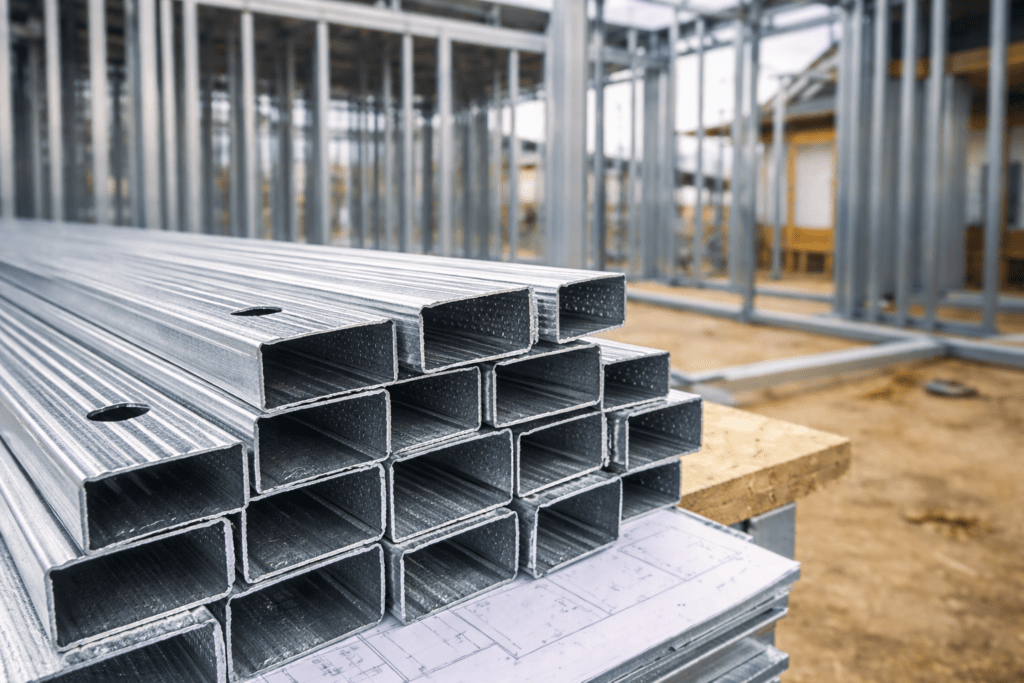
Light steel framing construction waste drops dramatically because framing members are roll-formed to exact lengths in a controlled manufacturing facility.
Instead of cutting studs manually on site:
Studs arrive pre-cut to engineered dimensions
Openings are pre-planned
Panelized systems reduce field modification
Material quantities align precisely with shop drawings
Precision fabrication reduces scrap accumulation. Crews install rather than measure and trim.
This shift from field fabrication to factory production reduces material loss significantly.
No Warping, Twisting, or Moisture Damage
Wood framing waste often results from:
Warped studs
Moisture swelling
Cracking
Improper storage
Material rejection
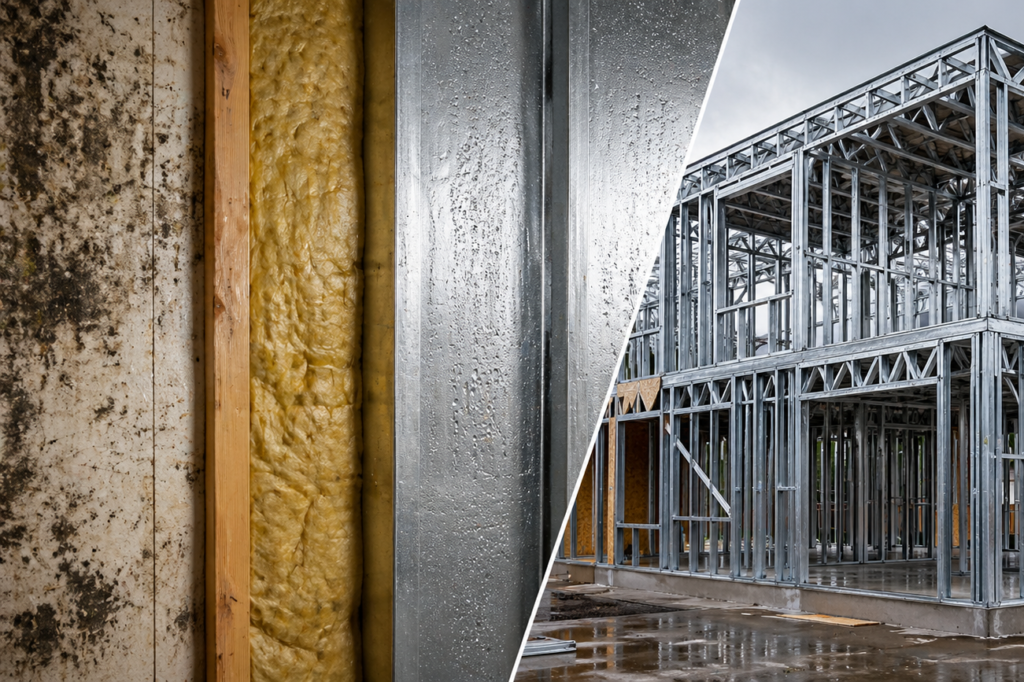
Steel does not warp. It does not twist. It does not absorb moisture.
Cold-formed steel maintains dimensional stability from factory to installation. That consistency prevents material rejection on site.
When material remains usable, waste decreases.
Accurate Material Estimation Improves Efficiency
Steel framing relies on engineered shop drawings. These drawings calculate:
Stud count
Track lengths
Bracing requirements
Panel dimensions
Digital modeling reduces over-ordering.
Traditional framing often includes a buffer because contractors expect cutting losses and damage. That buffer increases unused material at project completion.
Light steel framing construction waste decreases because quantities are calculated precisely before fabrication begins.
Recyclability Reduces Landfill Disposal
Steel offers a major advantage over wood. It is fully recyclable.
Even when scrap occurs:
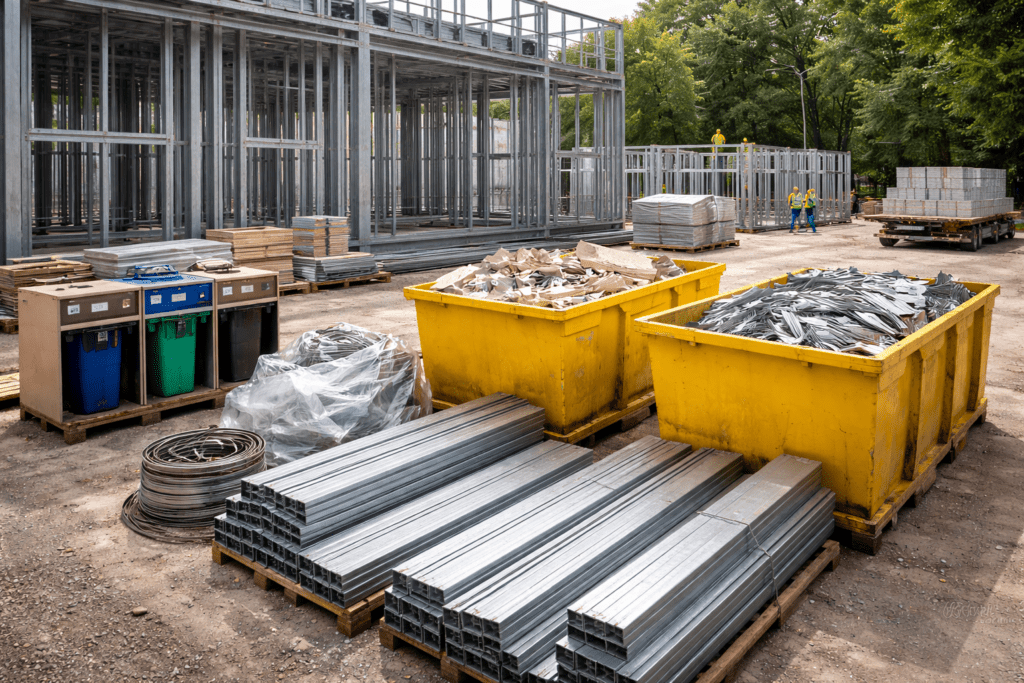
Off-cuts can be collected
Damaged pieces can be recycled
Steel retains material value
Wood scrap typically goes to landfill. Steel scrap re-enters the production cycle.
From a sustainability standpoint, this improves environmental reporting and ESG metrics for developers.
From a financial standpoint, recyclable scrap reduces net disposal cost.
Cleaner Job Sites Improve Productivity
Large-scale projects generate waste piles that slow crews and complicate inspections.
Steel framing produces:
Less loose debris
Fewer discarded materials
Cleaner staging areas
Reduced site clutter
Cleaner sites lead to:
Faster inspections
Lower safety risk
Better crew efficiency
Reduced material handling
Waste reduction improves overall workflow.
Panelized and Modular Systems Amplify Waste Reduction
Panelized and modular construction methods reduce construction waste even further.
Factory-controlled production allows:
Batch optimization
Material nesting efficiency
Automated cutting precision
Controlled inventory tracking
On-site waste becomes minimal because wall panels arrive ready for installation.
Modular construction enhances efficiency by assembling large portions of the structure off-site. Waste remains concentrated within the manufacturing facility, where it is easier to manage and recycle.
For multi-unit residential buildings, this model significantly lowers total site waste.
Financial Impact of Waste Reduction
Developers often underestimate the financial impact of construction waste.
Reduced waste results in:
Lower landfill tipping fees
Fewer disposal bin rentals
Less hauling cost
Reduced labor spent handling debris
Lower risk of rework
On large-scale projects, even a modest reduction in material waste can translate into substantial savings.
Waste reduction directly protects margins.
Environmental Compliance and Green Building Goals
Municipalities increasingly evaluate sustainability performance.
Light steel framing construction waste reduction supports:
LEED considerations
Municipal sustainability guidelines
Corporate ESG reporting
Waste diversion targets
Steel framing aligns with modern environmental expectations without compromising structural performance.
Sustainability is now a competitive advantage.
Comparing Light Steel Framing to Traditional Wood Waste
Wood framing typically produces:
Cut-off scrap
Damaged studs
Moisture-compromised material
Excess packaging
Framing rework from dimensional instability
Light steel framing produces:
Minimal cut-offs
No moisture damage
Predictable dimensional accuracy
Recyclable scrap
The difference becomes more noticeable as project scale increases.
Mid-rise and multi-unit developments benefit the most from precision-based systems.
Why Waste Reduction Matters for Developers
Light steel framing construction waste reduction provides strategic value.
It supports:
Cost control
Schedule reliability
Sustainability positioning
Cleaner job sites
Reduced inspection complications
When combined with structural precision and scalability, steel framing becomes more than a framing method. It becomes a project efficiency strategy.
For developers building large residential or mixed-use projects in Canada, reducing waste improves both environmental and financial performance.