When designing with light gauge steel, one concept must be clearly understood and correctly applied: axial load capacity of cold-formed steel studs. This is not just a theoretical parameter. It directly determines whether a wall system will perform safely under real loads in Ontario’s demanding construction environment.
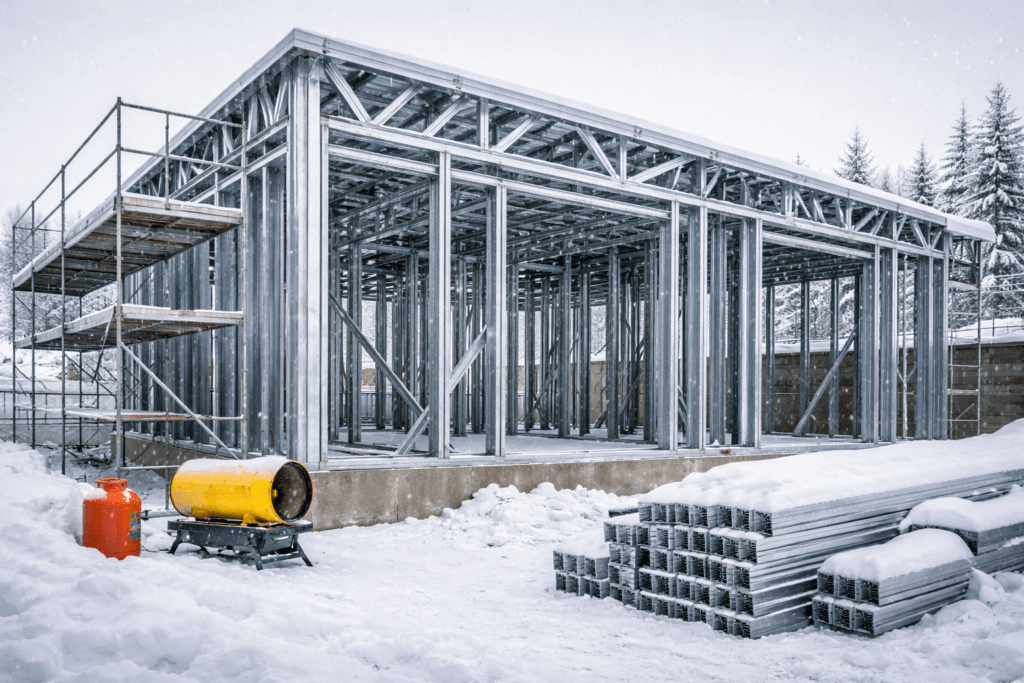
Across Canada, cold-formed steel framing has become a preferred solution for residential, commercial, and mid-rise construction. The material offers consistency, speed of installation, and predictable structural behavior. However, these advantages only translate into real performance when axial capacity is properly evaluated and integrated into the design.
This article explains how axial load capacity works in practice and what factors must be considered to ensure a safe and efficient design.
Understanding Axial Load Capacity in Cold-Formed Steel
Axial load capacity refers to the maximum vertical load a steel stud can carry before it becomes unstable or fails. In a typical structure, this load comes from floors, roofs, and any structural components above the wall system.
Unlike heavy structural steel, cold-formed steel studs are thin-walled sections. This means their failure is rarely due to crushing of the material. Instead, failure is governed by instability, particularly buckling. Because of this, the design approach must go beyond simple strength calculations and focus heavily on geometry, support conditions, and system behavior.
In practical terms, a stud that appears strong based on material strength alone may still fail if it is too slender or insufficiently braced. That is why axial load capacity must always be evaluated in context.
The Role of Stud Geometry and Thickness
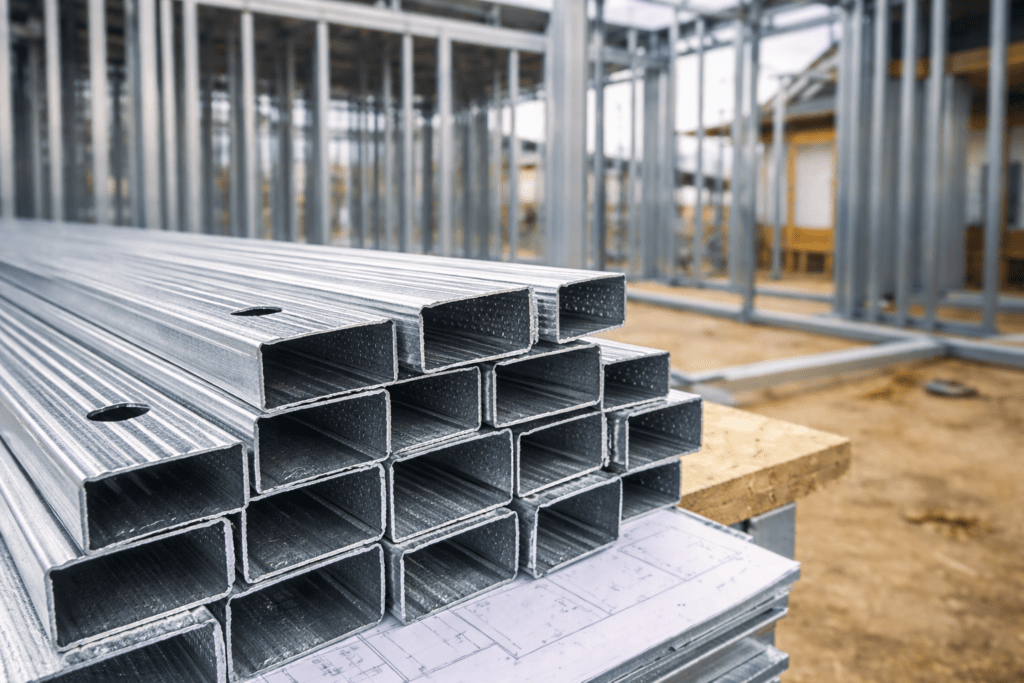
The geometry of a cold-formed steel stud plays a central role in determining its axial capacity. Both the depth of the stud and the thickness of the steel contribute to its performance, but they do so in different ways.
Increasing the thickness of the steel improves the overall strength of the section. In Canadian construction, studs range from lighter gauges used for non-load-bearing walls to heavier gauges intended for structural applications. While thicker material does increase capacity, it also raises material costs, which is not always the most efficient solution.
Depth, on the other hand, has a strong influence on the stud’s resistance to buckling. A deeper stud provides a higher moment of inertia, which allows it to resist lateral deflection under load more effectively. In many cases, increasing the depth of the stud provides a more economical improvement in axial capacity than increasing thickness.
This is why experienced designers often prioritize section geometry before increasing material weight.
Why Unbraced Length Is Critical
One of the most important and often underestimated factors in axial load capacity is unbraced length. This refers to the distance along the stud where no lateral support is provided.
As this length increases, the risk of buckling increases significantly. Even a strong and well-sized stud can lose a large portion of its load capacity if it is not properly braced.
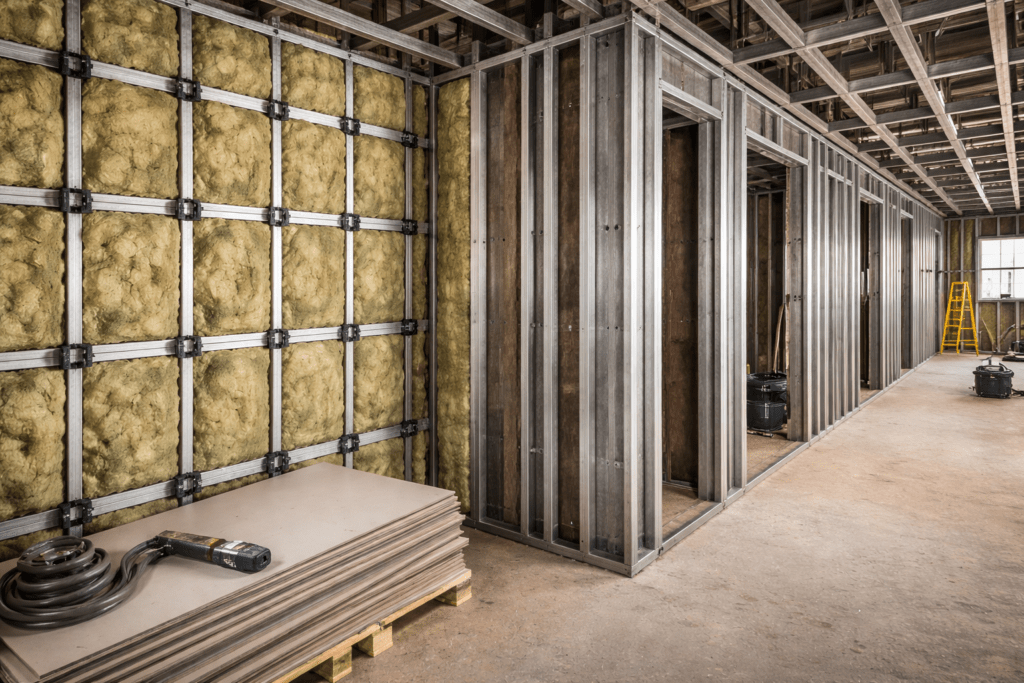
In real construction across Ontario and the GTA, lateral support is typically provided by sheathing materials such as gypsum board or OSB, as well as bridging systems and blocking. These elements reduce the effective unbraced length and allow the stud to carry higher loads safely.
From a design perspective, reducing unbraced length is often one of the most efficient ways to increase axial capacity without changing the stud size or thickness. It is a practical solution that can be implemented on-site without major cost increases.
Buckling Behavior in Cold-Formed Steel Studs
Buckling governs the design of cold-formed steel members. There are multiple modes of buckling that must be considered, and each one affects the axial load capacity differently.
Local buckling occurs within individual elements of the cross-section, such as the web or flange. Distortional buckling affects the shape of the entire cross-section, particularly around the flange and lip areas. Global buckling involves the entire stud bending or flexing under load.
A proper design must consider all three modes. Ignoring any one of them can lead to an overestimation of capacity and potential structural issues.
In Canada, these calculations are governed by CSA S136, which provides the framework for evaluating each type of buckling and determining safe load limits. Compliance with this standard is essential for engineering approval and code compliance.
Material Strength and Its Limitations
The steel used in cold-formed studs typically has a high yield strength, often ranging from 230 MPa to 550 MPa depending on the product. While higher strength steel does increase axial capacity, its benefits are only realized when buckling is properly controlled.
In other words, simply using stronger steel does not automatically result in a stronger wall system. If the stud is slender or poorly braced, buckling will still govern the design, and the additional material strength will not be fully utilized.
This is a key point that is often misunderstood. Efficient design is not about maximizing strength in isolation. It is about balancing material properties with geometry and support conditions.
Load Combinations Under Canadian Codes
In real projects, axial load capacity must be evaluated under combined loading conditions. The National Building Code of Canada requires that structures be designed to resist combinations of dead loads, live loads, snow loads, wind forces, and, in some cases, seismic effects.
This means that a stud is rarely subjected to pure axial load. Instead, it must carry vertical loads while also resisting lateral forces. These combined effects reduce the effective capacity of the stud and must be accounted for during design.
Engineers typically use interaction equations to evaluate these conditions, ensuring that the stud performs safely under all expected scenarios. This is especially important in Ontario, where snow and wind loads can be significant depending on the region.
Practical Design Approach for Builders
From a practical standpoint, achieving the required axial load capacity is not about selecting the heaviest stud available. It is about making informed decisions that balance performance and cost.
In many cases, improving lateral support through proper sheathing and bridging will have a greater impact than increasing material thickness. Adjusting stud spacing can also improve load distribution across the wall system, reducing the demand on individual members.
Connection design is another critical factor. Even if the stud itself has sufficient capacity, weak or poorly designed connections can limit the overall performance of the system. Load transfer must be continuous and reliable from the top of the wall to the foundation.
Builders who understand these relationships are able to optimize their designs, reduce unnecessary material costs, and avoid delays during engineering review.
Importance for Ontario and Canadian Construction
Construction in Ontario requires strict adherence to building codes and engineering standards. Projects must satisfy both structural performance requirements and regulatory approvals.
Cold-formed steel framing is well suited for this environment, but only when it is properly designed. Understanding the axial load capacity of cold-formed steel studs is essential for ensuring compliance, avoiding redesigns, and maintaining project timelines.
With increasing demand for mid-rise buildings and more efficient construction methods, the importance of accurate and optimized steel design continues to grow.
Work with LSF Pro Structures
At LSF Pro Structures, we specialize in cold-formed steel framing solutions tailored for Ontario and Canadian construction. We provide practical design support, manufacturing-ready data, and expertise that ensures your project meets all structural and code requirements.
If you are planning a project and want to ensure the correct axial load capacity of cold-formed steel studs is achieved without overdesigning, contact LSF Pro Structures today.