
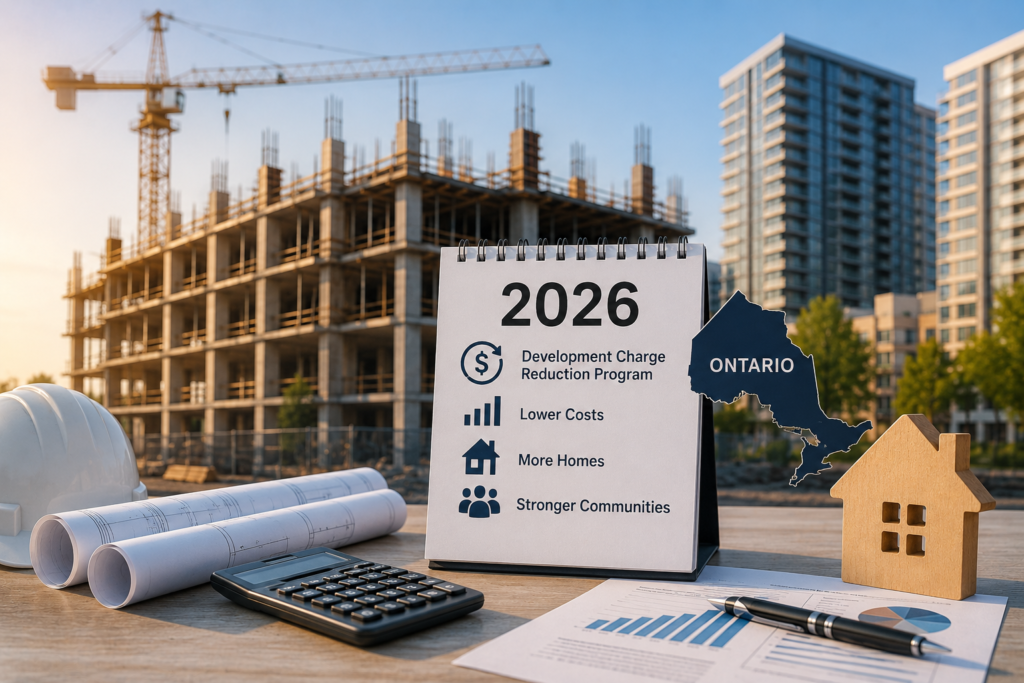
Ontario developers received significant news in 2026 with the launch of the new Ontario development charge reduction program, a joint initiative between the provincial and federal governments aimed at accelerating housing construction while supporting municipal infrastructure investment.
For builders, developers, and investors across Ontario, the program has the potential to reduce development costs substantially while improving project feasibility. More importantly, recently released provincial guidelines confirmed that eligible development charge reductions may apply retroactively to certain projects.
If you’re planning residential development in Ontario, understanding how this program works could have a meaningful impact on your project’s economics.
Why Development Charges Matter
Development charges are one of the largest upfront costs associated with new housing projects.
Municipalities collect these fees to help fund infrastructure required to support growth, including:
- Roads
- Water systems
- Wastewater infrastructure
- Transit
- Community services
While these investments are necessary, development charges have increased significantly in many Ontario municipalities over the past decade.
For developers, these costs directly affect:
- Project feasibility
- Housing affordability
- Financing requirements
- Construction timelines
Reducing development charges has become a major focus in efforts to increase housing supply across the province.
What Is the Ontario Development Charge Reduction Program?
The Ontario development charge reduction program is a collaborative initiative between the Government of Ontario and the Government of Canada.
The program allows participating municipalities to reduce development charges while receiving financial support from provincial and federal funding programs.
Under the framework announced in 2026:
- Municipalities must apply to participate.
- Municipalities must contribute at least 10% of eligible project costs.
- Provincial and federal governments can fund up to 90% of eligible reductions.
- The objective is to encourage housing construction while ensuring municipalities can continue investing in critical infrastructure.
This approach attempts to address one of the biggest concerns municipalities have historically raised regarding development charge reductions: replacing lost infrastructure funding.
The Most Important Update for Developers
One of the most significant elements of the recently released guidelines is the confirmation of retroactive eligibility.
According to the provincial guidelines, eligible development charge reductions may apply to projects where building permits were issued after March 30, 2026.
This means some projects that have already moved into the permit stage may still benefit from the program, depending on municipal participation and program eligibility requirements.
For developers who recently pulled permits, this could represent a meaningful financial opportunity.
How the Program Could Affect Housing Projects
The impact of development charges varies widely across Ontario.
In some municipalities, development charges represent a substantial portion of total project costs.
For residential projects, lower development charges can improve:
- Project viability
- Return on investment
- Cash flow requirements
- Housing affordability
This is particularly important for:
- Multi-unit residential developments
- Purpose-built rental projects
- Mid-rise housing
- Missing-middle housing initiatives
As housing costs continue to rise, reducing upfront municipal fees may help bring more projects to market.
Why This Matters for Ontario’s Housing Supply
Ontario continues to face significant housing supply challenges.
Government housing targets require a substantial increase in residential construction over the coming years.
Many industry organizations have identified development charges as one of the barriers to delivering new housing quickly and affordably.
By reducing these charges while maintaining municipal infrastructure funding, the Ontario development charge reduction program aims to support both housing growth and community development.
The success of the program will likely depend on how many municipalities choose to participate and how quickly implementation occurs.
What Developers Should Do Now
Developers should review the program carefully and determine whether their projects may qualify.
Key considerations include:
- Permit issuance date
- Municipal participation status
- Project type and eligibility requirements
- Timing of future applications
Projects that recently received permits may warrant particular attention due to the retroactive provisions outlined in the provincial guidelines.
Because implementation details may continue to evolve, staying informed will be important over the coming months.
How Faster Construction Can Maximize Program Benefits
Reducing development charges improves project economics, but overall project success still depends heavily on construction efficiency.
Developers are increasingly looking for ways to:
- Reduce carrying costs
- Accelerate schedules
- Improve labour efficiency
- Bring housing units to market sooner
This is one reason light steel framing continues to gain momentum across Ontario.
Faster construction timelines can amplify the financial benefits created by reduced development charges, helping developers improve both project delivery and overall returns.
The Opportunity for Multi-Unit Housing
The greatest impact of the Ontario development charge reduction program may be seen in multi-unit residential construction.
Projects that combine:
- Reduced development charges
- Faster permit processing
- Efficient construction systems
- Strong project planning
will be positioned to capitalize on Ontario’s ongoing housing demand.
As municipalities begin implementing the program, developers who act early may gain a competitive advantage.
Looking Ahead
The Ontario development charge reduction program represents one of the most significant housing-related funding initiatives introduced in recent years.
By helping municipalities reduce development charges while maintaining infrastructure investment, the program seeks to remove a major barrier to housing construction.
For developers, the opportunity extends beyond cost savings. It may influence project feasibility, financing, and long-term development strategy.
As additional implementation details become available, the program is likely to become an increasingly important consideration for residential projects across Ontario.
Work with LSF Pro Structures
At LSF Pro Structures, we help Ontario developers deliver projects faster through advanced light steel framing and prefabricated construction solutions.
As development incentives improve project economics, construction efficiency becomes even more important. Our engineered framing systems help reduce build times, improve quality control, and support faster project delivery.
If you’re planning a residential development in Ontario, contact LSF Pro Structures to learn how light steel framing can help maximize your project’s success.