As solar energy adoption continues to grow across Canada, the focus is no longer just on the panels themselves. Increasingly, developers, engineers, and solar installers are paying close attention to the structural systems that support them.
A solar installation is only as reliable as the structure beneath it. That is why cold-formed steel solar mounting structures are becoming the preferred solution for many commercial, industrial, agricultural, and utility-scale projects.
From superior durability to faster manufacturing and installation, cold-formed steel offers several advantages that make it particularly well-suited for solar panel support systems in Canadian conditions.
The Growing Demand for Reliable Solar Support Structures
Solar projects are expected to perform for decades.
Whether installed on rooftops, carports, agricultural land, or ground-mounted arrays, the supporting structure must withstand years of exposure to:
- Snow loads
- Wind loads
- Temperature fluctuations
- Moisture and corrosion
- Seasonal freeze-thaw cycles
In Canada, these environmental demands are especially significant.
As a result, selecting the right structural material is just as important as selecting the solar equipment itself.
What Is a Cold-Formed Steel Solar Mounting Structure?
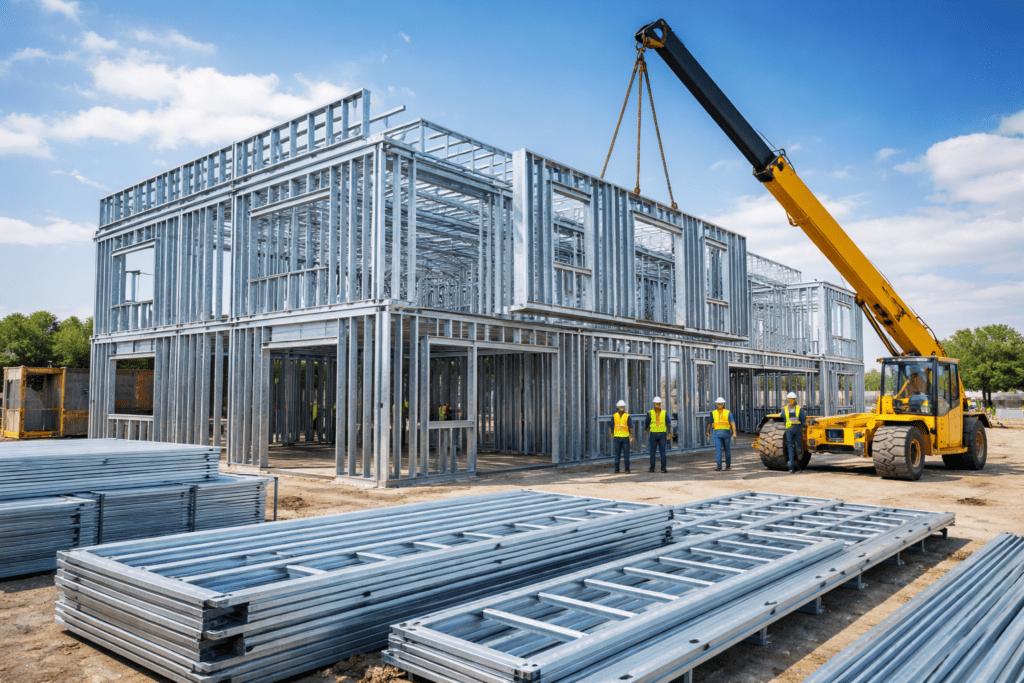
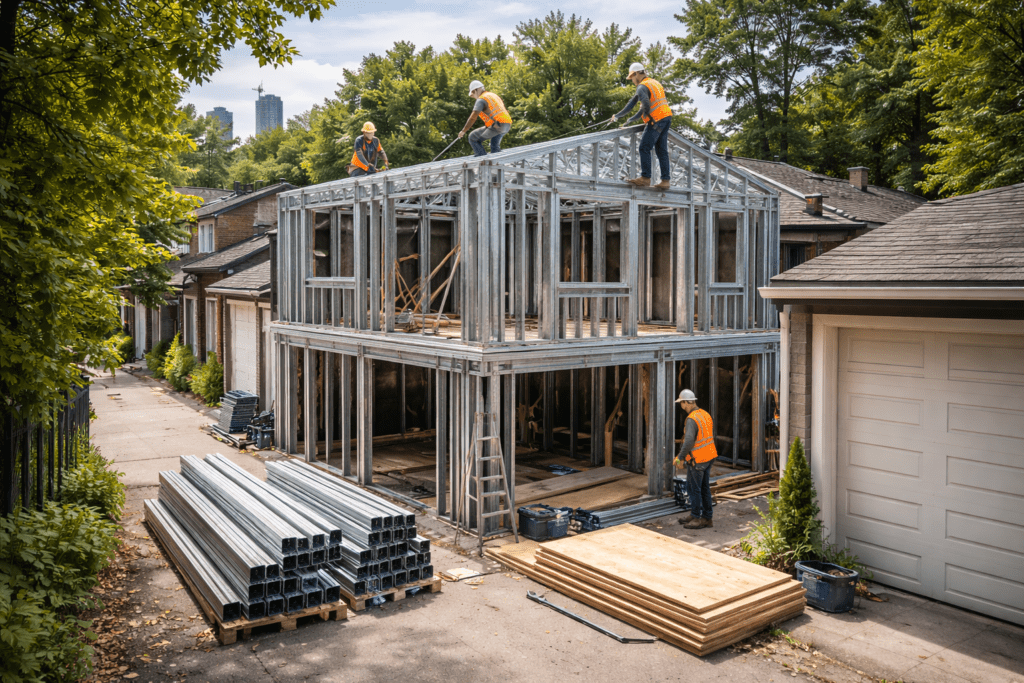
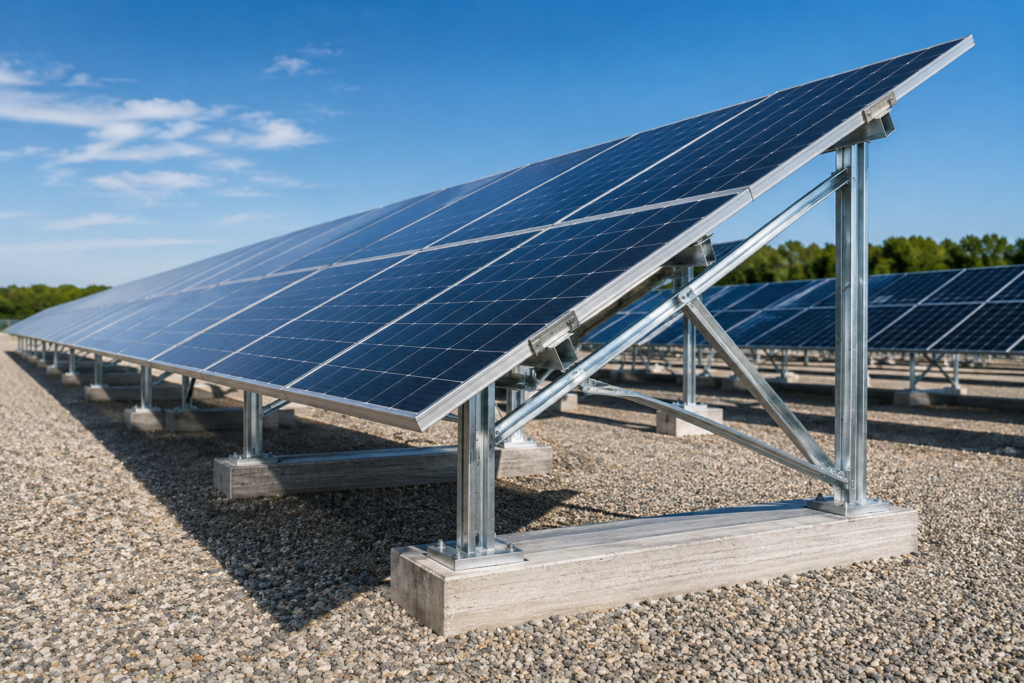
A cold-formed steel solar mounting structure is a support system manufactured from roll-formed galvanized steel sections.
Unlike hot-rolled steel, cold-formed steel achieves its strength through engineered profiles and efficient geometry. These profiles are manufactured with precision and can be optimized specifically for solar applications.
The result is a lightweight yet highly capable structural system that can support significant loads while remaining economical to manufacture and install.
Strength-to-Weight Ratio Creates Major Advantages
One of the biggest benefits of cold-formed steel is its exceptional strength-to-weight ratio.
Solar mounting systems must support:
- The weight of solar panels
- Wind uplift forces
- Snow accumulation
- Maintenance loads
Cold-formed steel delivers high structural capacity without excessive weight.
This provides several advantages:
- Easier transportation
- Faster installation
- Reduced foundation requirements
- Lower handling costs
For large solar fields or rooftop systems, these savings can become substantial.
Superior Performance in Canadian Snow Loads
Snow loading is one of the most important design considerations for solar installations in Canada.
Many regions of Ontario experience significant snow accumulation each winter. Solar support structures must be capable of carrying these loads safely throughout the life of the installation.
Cold-formed steel solar mounting structures are particularly effective because they can be engineered precisely for local snow load requirements.
Rather than relying on oversized structural members, engineers can optimize the framing system to achieve both performance and efficiency.
This results in a safer and more economical design.
Excellent Corrosion Resistance
Solar projects are long-term investments.
The supporting structure must perform reliably for decades with minimal maintenance.
Galvanized cold-formed steel provides excellent corrosion protection through zinc coatings such as G90 galvanization.
This protective layer helps resist:
- Moisture exposure
- Humidity
- Weathering
- Environmental corrosion
For outdoor solar installations, corrosion resistance is one of the most important factors affecting long-term durability.
Properly specified galvanized steel structures can provide decades of service with minimal degradation.
Precision Manufacturing Improves Installation Efficiency
Modern cold-formed steel systems are manufactured using advanced roll-forming technology.
Components can be:
- Pre-cut
- Pre-punched
- Pre-labeled
- Manufactured to exact dimensions
This level of precision improves installation efficiency significantly.
Instead of extensive field fabrication, installers receive components ready for assembly.
The result is:
- Faster installation
- Reduced labour costs
- Improved quality control
- Greater consistency across the project
For large-scale solar developments, these efficiencies can have a major impact on overall project economics.
Scalability for Small and Large Projects
One of the unique advantages of cold-formed steel is its versatility.
The same manufacturing approach can support:
- Residential solar systems
- Commercial rooftop arrays
- Solar carports
- Agricultural solar installations
- Utility-scale ground-mounted projects
This scalability allows developers to standardize structural solutions across multiple project types while maintaining efficiency.
Better Logistics and Transportation
Transportation costs can become a major expense for solar projects.
Cold-formed steel components are lightweight and compact compared to many traditional structural systems.
This allows:
- More material per truckload
- Lower transportation costs
- Easier site handling
- Reduced equipment requirements
For remote project locations, these logistical advantages become even more valuable.
Sustainability Supports Renewable Energy Goals
The structural system should support the sustainability objectives of the solar project itself.
Cold-formed steel contributes to these goals because it is:
- Highly recyclable
- Efficient to manufacture
- Capable of reducing material waste
- Suitable for long service life applications
Many developers appreciate the fact that the supporting structure aligns with the environmental benefits of solar energy production.
Why Engineers Prefer Cold-Formed Steel
Engineers increasingly choose cold-formed steel solar mounting structures because they offer a high degree of design flexibility.
Members can be optimized for:
- Wind loading
- Snow loading
- Panel orientation
- Site conditions
- Foundation requirements
This flexibility allows engineers to create highly efficient structural systems tailored to each project.
The result is improved performance without unnecessary material costs.
The Future of Solar Support Structures
As solar deployment accelerates across Ontario and Canada, support structure technology is evolving as well.
Developers are looking for systems that provide:
- Long-term durability
- Faster installation
- Lower lifecycle costs
- Better structural efficiency
Cold-formed steel meets all of these requirements.
Its combination of strength, corrosion resistance, manufacturability, and cost efficiency makes it one of the most attractive options available for modern solar infrastructure.
Practical Takeaway
Solar panels may generate the power, but the support structure determines how reliably that system performs over time.
Cold-formed steel offers a unique combination of:
- Structural strength
- Corrosion resistance
- Precision manufacturing
- Installation efficiency
- Long-term durability
That is why cold-formed steel solar mounting structures are becoming the preferred choice for a growing number of solar projects across Canada.
Work with LSF Pro Structures
At LSF Pro Structures, we design and manufacture precision-engineered cold-formed steel systems for a wide range of structural applications, including solar panel mounting structures and racking systems.
Our advanced manufacturing capabilities allow us to deliver durable, efficient, and cost-effective solutions tailored to Canadian conditions.
If you’re planning a solar project and want to explore the advantages of cold-formed steel support structures, contact LSF Pro Structures today.