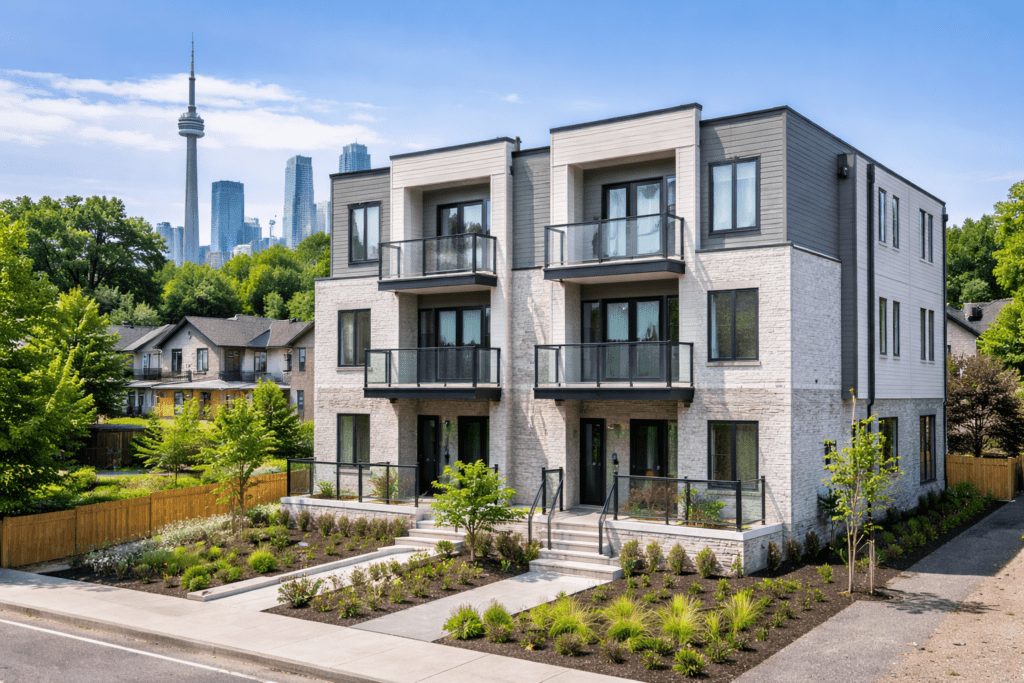
Ontario’s housing market is evolving rapidly. As municipalities push for greater density and faster housing delivery, four- to eight-storey buildings have become one of the most active segments of residential construction.
These mid-rise projects offer an attractive balance between density, construction cost, and urban integration. However, they also present unique structural and logistical challenges.
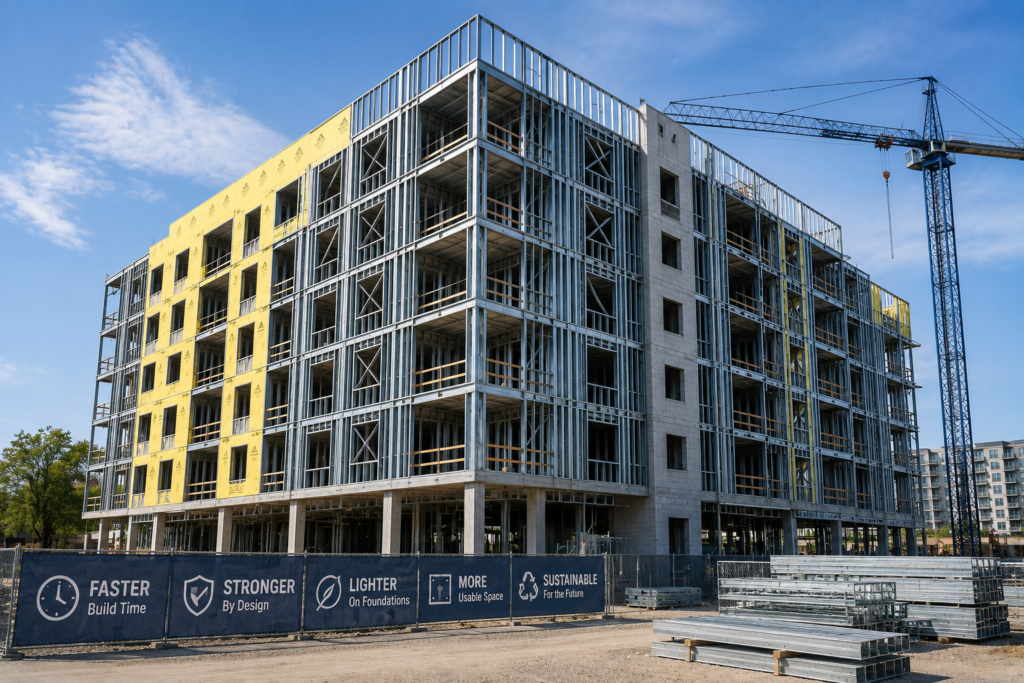
This is one reason why steel framing for mid-rise buildings is gaining momentum across Ontario. Developers are increasingly turning to light steel framing systems to improve efficiency, reduce risk, and accelerate project delivery.
As the demand for housing continues to grow, steel framing is becoming a strategic advantage rather than simply an alternative construction method.
Why Four- to Eight-Storey Buildings Are Growing in Popularity
Ontario municipalities are actively encouraging “missing middle” housing and mid-rise development.
Projects in the four- to eight-storey range help cities:
- Increase housing supply
- Improve land utilization
- Support transit-oriented communities
- Create higher-density neighborhoods without high-rise construction
For developers, these projects often provide attractive economics while remaining easier to approve and construct than larger towers.
As a result, mid-rise construction is becoming increasingly common throughout the Greater Toronto Area and across Ontario.
The Challenges of Mid-Rise Construction
While mid-rise buildings offer many advantages, they also introduce structural requirements that differ significantly from low-rise projects.
Developers must address:
- Higher structural loads
- More complex load paths
- Fire-resistance requirements
- Acoustic separation requirements
- Tight construction schedules
- Labour availability challenges
Traditional building methods can meet these requirements, but often with increased cost and complexity.
This is where steel framing for mid-rise buildings provides a compelling alternative.
Strength Without Excessive Weight
One of the biggest advantages of light steel framing is its exceptional strength-to-weight ratio.
As buildings increase in height, structural efficiency becomes increasingly important.
Cold-formed steel allows engineers to achieve substantial load capacity without introducing unnecessary weight into the structure.
This creates several benefits:
- Reduced foundation loads
- Lower structural dead loads
- More efficient material usage
- Easier transportation and handling
For four- to eight-storey buildings, these advantages can significantly improve project economics.
Faster Construction Schedules
Speed has become a major priority for Ontario developers.
Every month added to a project schedule increases:
- Financing costs
- Site overhead
- Labour expenses
- Project risk
Steel framing systems help reduce these pressures.
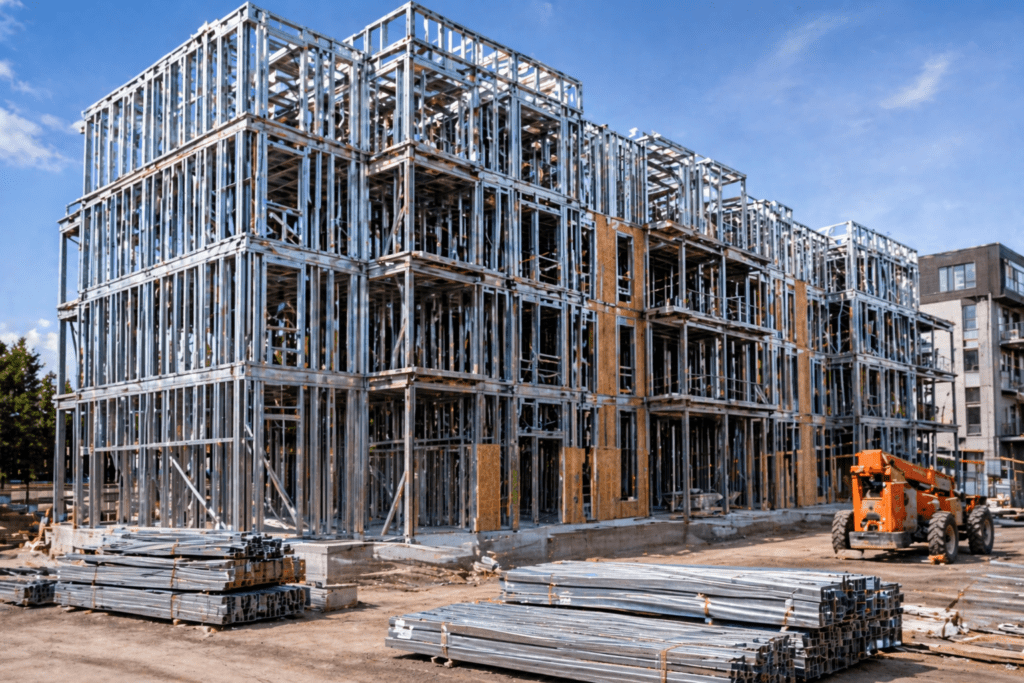
Because components can be manufactured with precision before arriving on site, framing installation becomes faster and more predictable.
Prefabricated wall panels and engineered framing systems allow projects to move forward with less dependence on extensive field fabrication.
For developers, faster framing often translates into faster occupancy and earlier revenue generation.
Improved Precision and Quality Control
As buildings become larger, maintaining consistency becomes more difficult.
Small framing inaccuracies that may be manageable in a low-rise project can create significant challenges when repeated across multiple floors.
Steel framing is manufactured to precise dimensions, providing:
- Better alignment
- Improved dimensional consistency
- More accurate openings
- Reduced cumulative construction errors
This precision benefits not only the structural system but also downstream trades such as drywall, glazing, and mechanical contractors.
Fire Performance Supports Mid-Rise Construction
Fire safety is one of the most important considerations in multi-storey residential buildings.
Because steel is non-combustible, it aligns well with many of the fire-performance requirements associated with mid-rise construction.
When combined with properly designed assemblies, steel framing helps support:
- Fire separation requirements
- Building code compliance
- Long-term safety objectives
This is one reason many developers view steel framing for mid-rise buildings as a practical solution for modern residential construction.
Labour Challenges Are Changing Construction Decisions
Ontario’s construction industry continues to face labour shortages.
Projects that depend heavily on large on-site framing crews are becoming increasingly difficult to manage.
Steel framing helps address this challenge by shifting more work into controlled manufacturing environments.
The result is:
- Reduced site labour requirements
- Improved productivity
- More predictable scheduling
- Less exposure to labour market fluctuations
For developers, reducing labour risk has become just as important as reducing material costs.
Better Suitability for Prefabrication
Mid-rise buildings benefit greatly from repetition.
The same wall types, layouts, and structural details often occur across multiple floors.
This makes them ideal candidates for prefabrication.
Steel framing systems can be manufactured as:
- Wall panels
- Floor assemblies
- Structural framing packages
By leveraging prefabrication, developers can improve quality control while significantly reducing construction time.
This is one of the primary reasons steel framing continues to gain popularity in the four- to eight-storey market.
Long-Term Durability Matters
Mid-rise residential buildings are long-term investments.
Developers, owners, and investors all want structures that maintain performance over decades.
Steel framing offers several durability advantages:
- Resistance to warping
- Resistance to shrinking
- Resistance to termites and pests
- Improved dimensional stability
These characteristics help reduce maintenance issues and improve long-term building performance.
Why Ontario Developers Are Making the Shift
The growing adoption of steel framing for mid-rise buildings is not driven by a single factor.
It is the result of several industry trends converging at the same time:
- Increased housing demand
- Pressure to accelerate construction
- Labour shortages
- Growing interest in prefabrication
- Stricter building performance expectations
Steel framing addresses many of these challenges simultaneously.
That makes it an increasingly attractive solution for developers looking to stay competitive.
The Future of Mid-Rise Construction in Ontario
As municipalities continue promoting higher-density housing, four- to eight-storey buildings will likely play an even larger role in Ontario’s housing strategy.
Developers who embrace efficient construction systems will be better positioned to meet market demand while maintaining project profitability.
Steel framing is emerging as one of the most effective tools available for achieving that goal.
Its combination of speed, precision, durability, and structural efficiency aligns closely with the future of residential construction in Canada.
Practical Takeaway
Four- to eight-storey buildings occupy a unique position in Ontario’s housing market.
They require greater structural performance than low-rise construction while demanding greater efficiency than traditional building methods often provide.
Steel framing for mid-rise buildings offers a practical solution by delivering:
- Faster construction
- Reduced labour dependency
- Improved quality control
- Long-term durability
- Strong structural performance
These advantages explain why more developers are making the switch.
Work with LSF Pro Structures
At LSF Pro Structures, we specialize in engineered light steel framing systems designed specifically for mid-rise residential construction across Ontario.
Our advanced manufacturing and prefabrication capabilities help developers reduce schedules, improve quality, and build more efficiently.
If you’re planning a four- to eight-storey project and want to explore the advantages of steel framing, contact LSF Pro Structures today.