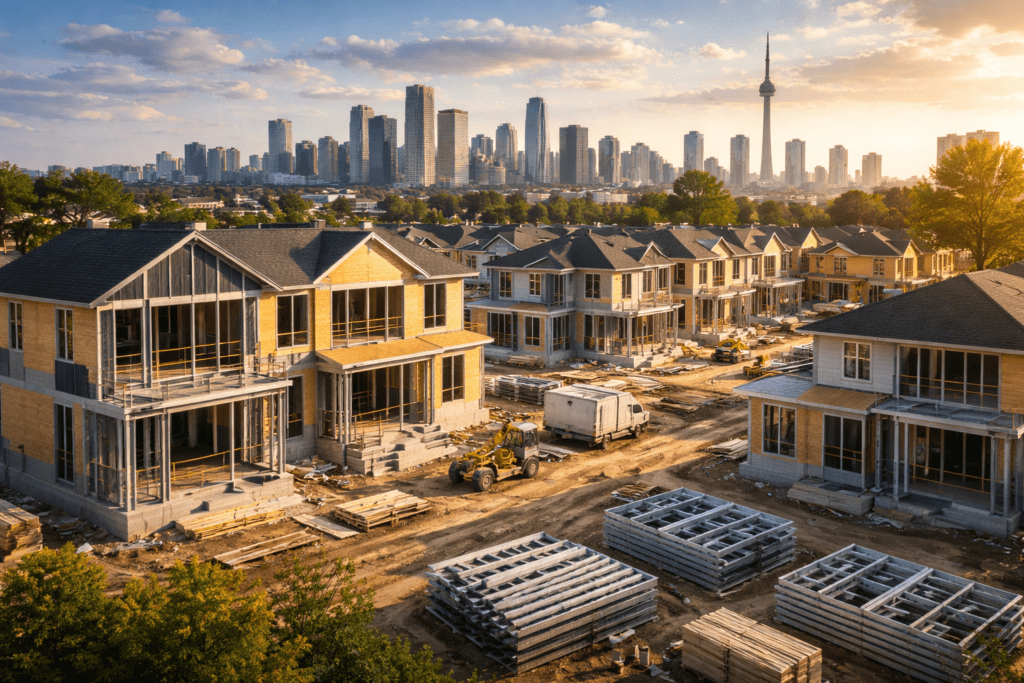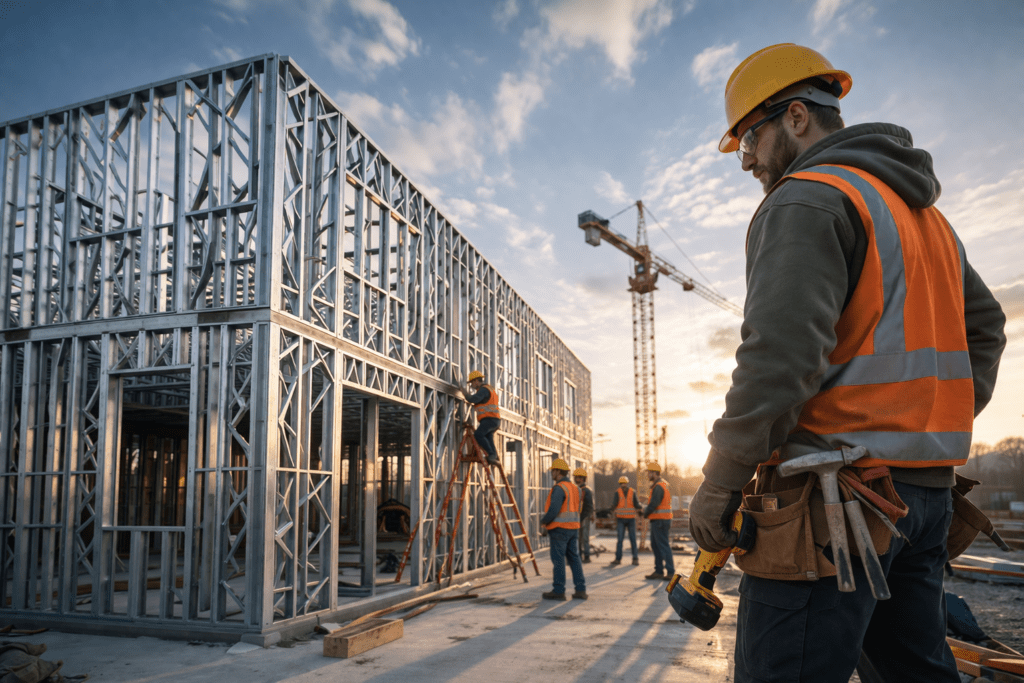
Ontario’s construction industry is facing one of its biggest challenges in decades: a shortage of skilled labour.
As housing demand continues to increase and governments push for faster housing delivery, builders are struggling to find enough qualified workers to keep projects moving. Labour shortages are affecting schedules, increasing costs, and making project planning more difficult than ever.
In response, many developers are turning to prefabricated steel construction as a way to reduce labour dependency while improving efficiency and quality.
What was once considered an alternative construction method is quickly becoming a practical solution to one of the industry’s most pressing problems.
Ontario’s Growing Labour Challenge
The demand for new housing across Ontario continues to rise, particularly in major markets such as Toronto, Mississauga, Hamilton, Ottawa, and the surrounding regions.
At the same time, the construction workforce faces several challenges:
- Retirement of experienced tradespeople
- Fewer young workers entering the skilled trades
- Increasing competition for labour between projects
- Rising labour costs
- Ongoing pressure to accelerate construction timelines
These factors have created a significant gap between the amount of housing that needs to be built and the labour available to build it.
For developers, labour shortages are no longer an occasional inconvenience. They have become a major business risk.
How Labour Shortages Affect Construction Projects
Labour shortages impact far more than payroll costs.
When projects cannot secure sufficient skilled workers, the result is often:
- Construction delays
- Scheduling conflicts
- Reduced productivity
- Increased overtime costs
- Higher project risk
In many cases, delays create a ripple effect throughout the entire project.
A framing delay can postpone mechanical installation. Mechanical delays affect drywall schedules. Delayed finishing pushes occupancy further into the future.
For developers carrying construction financing, every additional month can significantly affect project profitability.
Why Traditional Construction Methods Are Under Pressure
Traditional construction relies heavily on field labour.
Much of the work is performed on-site, including:
- Measuring
- Cutting
- Framing
- Assembly
- Coordination between trades
As labour becomes harder to secure, this model becomes increasingly difficult to sustain.
The industry is now looking for ways to shift more work away from the job site and into controlled production environments.
This is where prefabricated steel construction enters the conversation.
What Is Prefabricated Steel Construction?
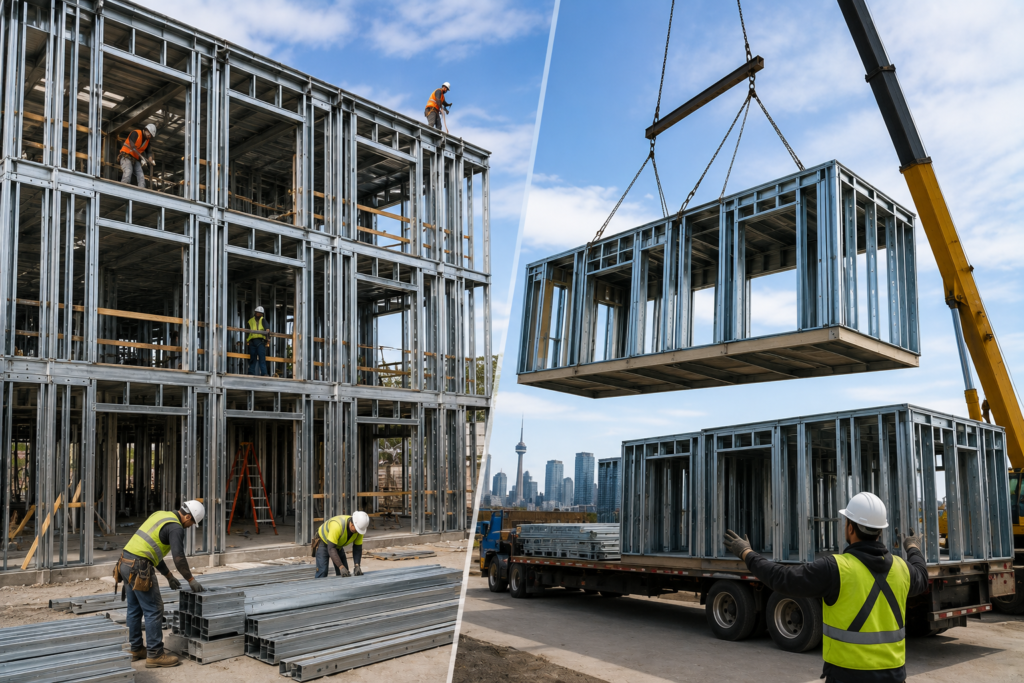
Prefabricated steel construction involves manufacturing structural components in a factory before they arrive at the construction site.
Rather than assembling everything in the field, components are produced with precision and delivered ready for installation.
These components may include:
- Wall panels
- Floor systems
- Roof trusses
- Structural framing assemblies
The construction site becomes primarily an assembly operation rather than a fabrication operation.
That distinction significantly changes labour requirements.
Reducing Labour Dependency
One of the biggest advantages of prefabricated steel construction is its ability to reduce dependence on large on-site crews.
Because much of the work is completed during manufacturing:
- Less cutting is required on site
- Fewer framing crews are needed
- Installation becomes more predictable
- Trade coordination becomes simpler
This allows developers to complete projects with fewer workers while maintaining productivity.
In today’s labour market, that advantage is becoming increasingly valuable.
Faster Construction Schedules
Labour shortages and construction delays often go hand in hand.
Prefabricated steel construction helps address both issues simultaneously.
Manufacturing can occur while site preparation is underway. Instead of waiting for sequential construction stages, multiple activities can happen at the same time.
This overlap shortens project schedules and improves efficiency.
For developers, faster construction means:
- Reduced carrying costs
- Lower site overhead
- Earlier occupancy
- Faster revenue generation
The schedule benefits alone often justify the move toward prefabrication.
Better Quality Control
Labour shortages can also affect quality.
When experienced workers are difficult to find, consistency becomes harder to maintain.
Prefabricated steel systems reduce this risk by moving critical work into controlled manufacturing environments.
There, production benefits from:
- Standardized processes
- Precision equipment
- Quality control procedures
- Consistent workmanship
This helps reduce installation errors and improves overall project quality.
Why Steel Works So Well with Prefabrication
Not all building materials are equally suited to prefabrication.
Cold-formed steel offers unique advantages because it can be manufactured with exceptional precision.
Modern roll-forming equipment can:
- Cut members to exact lengths
- Create service holes automatically
- Label components for assembly
- Produce consistent framing systems
This level of accuracy supports efficient panelization and large-scale manufacturing.
As a result, steel has become one of the most effective materials for industrialized construction.
Multi-Unit Housing Benefits the Most
The benefits of prefabricated steel construction become even greater in projects with repetitive layouts.
Multi-unit developments often include:
- Repeated floor plans
- Standardized wall types
- Consistent structural details
These characteristics are ideal for prefabrication.
Once a framing system is designed, it can be manufactured repeatedly with minimal variation.
This improves productivity while reducing labour requirements across the entire project.
Supporting Ontario’s Housing Goals
Ontario has ambitious housing targets for the coming years.
Meeting these targets will require more than additional funding and policy changes.
The industry must also improve construction productivity.
Prefabricated steel construction offers a practical path forward by allowing builders to produce more housing with fewer labour constraints.
Many industry experts believe that industrialized construction methods will play a major role in helping Ontario address its housing shortage.
Why Developers Are Paying Attention
The shift toward prefabrication is not simply about technology.
It is about reducing uncertainty.
Developers today are looking for solutions that provide:
- Predictable schedules
- Improved labour efficiency
- Better quality control
- Reduced project risk
Prefabricated steel construction delivers on all four.
As labour challenges continue to grow, its advantages become increasingly difficult to ignore.
The Future of Construction in Ontario
Labour shortages are unlikely to disappear in the near future.
As the construction industry adapts, more developers will seek systems that reduce reliance on traditional labour-intensive methods.
Prefabricated steel construction aligns perfectly with this transition.
It combines manufacturing efficiency with structural performance, creating a construction model better suited to modern market realities.
For many projects, it is no longer a question of whether prefabrication will be adopted. It is a question of how quickly.
Practical Takeaway
Ontario’s labour shortage is reshaping how buildings are designed and constructed.
Developers who continue relying solely on traditional methods may face increasing challenges related to cost, scheduling, and workforce availability.
Prefabricated steel construction offers a practical solution by:
- Reducing labour dependency
- Improving project efficiency
- Accelerating construction schedules
- Delivering more predictable outcomes
These advantages explain why its adoption continues to grow across the province.
Work with LSF Pro Structures
At LSF Pro Structures, we specialize in prefabricated light steel framing systems designed to help developers overcome labour challenges while improving project performance.
Our advanced manufacturing capabilities allow us to deliver precision-engineered framing solutions that reduce on-site labour requirements and accelerate construction schedules.
If you’re planning a project and want to learn how prefabricated steel construction can help address today’s labour challenges, contact LSF Pro Structures today.