
Toronto developers received one of the biggest housing policy announcements in recent years with the confirmation that the City of Toronto will reduce development charges by up to 60% for many residential projects.
The announcement is part of the Canada-Ontario Development Charges Reduction Program (DCRP), a joint initiative involving the federal government, the Province of Ontario, and the City of Toronto. Combined with new infrastructure funding and Ontario’s enhanced HST rebate program, these measures are designed to accelerate housing construction while improving project economics.
For developers, this is more than just a policy update. It has the potential to significantly reduce upfront costs, improve project feasibility, and encourage more residential development across the city.
If you’re planning a project in Toronto, here is what you need to know.
Why Development Charges Matter
Development charges are one of the largest municipal costs associated with new residential construction.
These fees help municipalities fund infrastructure required to support growth, including:
- Roads
- Transit
- Water and wastewater systems
- Community facilities
- Public services
While necessary for long-term city growth, development charges have become a major contributor to rising housing costs throughout the Greater Toronto Area.
For many developers, these charges directly affect:
- Project feasibility
- Construction financing
- Housing affordability
- Return on investment
Reducing them can dramatically improve project economics.
Toronto Announces Development Charge Reductions of Up to 60%
Under the new Development Charges Reduction Program, Toronto will receive up to $1.5 billion in provincial and federal funding over the next ten years.
In exchange, the City has committed to reducing development charges by 40% to 60%, exceeding the original provincial program requirements.
The largest reductions apply to:
- Single and semi-detached homes
- Multi-bedroom townhomes
- Two-bedroom and larger apartments
- Purpose-built rental housing with two or more bedrooms
- Dwelling rooms
One-bedroom apartments and bachelor units will receive a 40% reduction for both ownership and rental projects.
These reduced rates are expected to remain in place for a minimum of three years following City Council approval and execution of the funding agreement.
What This Means for Developers
For developers, lower development charges improve project viability almost immediately.
Development charges represent a significant upfront investment before a project begins generating revenue.
Reducing these costs improves:
- Cash flow
- Financing requirements
- Overall project feasibility
- Investment returns
According to the City of Toronto, the reductions are expected to provide approximately $1.95 billion in relief to homebuilders while helping unlock more than 44,000 new housing units.
For a new single or semi-detached home, development charge savings are estimated at approximately $83,000 per home.
Those numbers can substantially improve the financial performance of residential developments.
Infrastructure Investment Supports Future Growth
One of the concerns municipalities often raise about reducing development charges is how infrastructure will continue to be funded.
The Development Charges Reduction Program addresses this challenge by replacing much of the lost revenue through provincial and federal funding.
Toronto’s funding package will help support major infrastructure improvements, including:
- Transit expansion
- Watermain upgrades
- Road widening projects
- Traffic improvements
- New road connections
- Community growth infrastructure
Rather than slowing infrastructure investment, the program is intended to accelerate both housing construction and infrastructure development simultaneously.
For developers, this creates greater confidence that future growth areas will continue receiving the services required to support new communities.
Additional Support for Purpose-Built Rental Housing
The announcement also includes additional incentives for purpose-built rental housing.
The City of Toronto will expand its rental housing incentive program by providing an indefinite deferral of development charges for qualifying projects that include at least 20% affordable housing.
The first phase of this initiative supported more than 8,000 rental homes, including over 2,000 affordable units.
The second phase aims to support up to 10,000 additional rental homes.
For developers focused on rental housing, these incentives may significantly improve long-term project feasibility.
Ontario’s Enhanced HST Rebate Is Now Fully Operational
Another important development for builders is the implementation of Ontario’s enhanced HST rebate program.
Administrative regulations are now in place, allowing eligible purchasers and builders to access the new rebate process.
For qualifying new homes purchased between April 1, 2026, and March 31, 2027, buyers may receive relief equal to:
- The provincial 8% portion of the HST
- An additional Ontario top-up
In many transactions, builders can apply these credits at closing, reducing the final purchase price for eligible buyers.
The completion of the administrative framework provides much-needed certainty for builders who have been waiting for implementation details.
Why Faster Construction Now Matters Even More
Reducing development charges improves project economics, but maximizing those savings still depends on efficient project delivery.
Every month of construction carries financing costs, labour expenses, equipment costs, and site overhead.
Developers who combine lower municipal charges with faster construction schedules position themselves for even stronger returns.
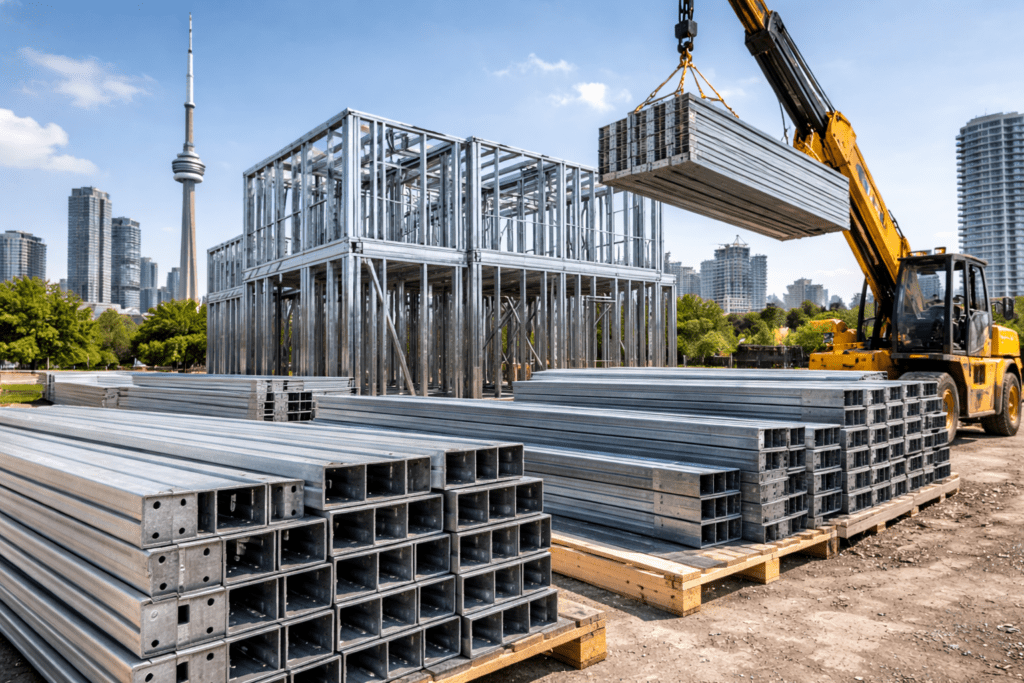
This is one reason light steel framing continues to gain momentum throughout Ontario.
Panelized and prefabricated light steel framing systems help reduce construction schedules by moving much of the framing process into controlled manufacturing environments.
Faster framing means:
- Earlier enclosure
- Better trade coordination
- Reduced labour dependency
- Earlier occupancy
When combined with lower development charges, faster construction creates an even greater financial advantage.
A Positive Shift for Toronto’s Housing Market
Toronto continues to face significant housing supply challenges.
Reducing development charges, expanding infrastructure investment, and improving tax incentives represent meaningful steps toward increasing housing production.
While these initiatives alone will not solve Ontario’s housing shortage, they remove several major financial barriers that have affected residential development for years.
Developers who take advantage of these programs while improving construction efficiency will be well positioned as new opportunities emerge.
Practical Takeaway
Toronto’s decision to reduce development charges by up to 60% represents one of the most significant cost-saving initiatives introduced for residential development in recent years.
Combined with new infrastructure funding and Ontario’s enhanced HST rebate program, developers now have greater financial certainty and improved project economics.
To fully capitalize on these opportunities, developers should also focus on construction methods that reduce schedules, improve quality, and lower overall project costs.
Together, policy improvements and efficient construction can help accelerate housing delivery across Toronto.
Work with LSF Pro Structures
At LSF Pro Structures, we help Ontario developers maximize the value of today’s housing incentives through advanced light steel framing and prefabricated construction solutions.
Our precision-engineered systems reduce construction schedules, improve quality control, and help projects reach occupancy sooner, allowing developers to maximize the financial benefits of reduced development charges and other government incentives.
If you’re planning a residential development in Toronto or anywhere in Ontario, contact LSF Pro Structures to learn how light steel framing can help improve your project’s performance.