Modular construction is rapidly transforming how buildings are designed and delivered across Canada. As demand for faster, more efficient construction grows, traditional methods are struggling to keep up.
In Ontario and other high-demand regions, builders are under pressure to deliver projects quicker, reduce costs, and maintain consistent quality. Modular construction offers a solution by shifting much of the work off-site into controlled manufacturing environments.
At the center of this shift is steel framing. It plays a critical role in making modular construction scalable, reliable, and structurally sound.
What Is Modular Construction?
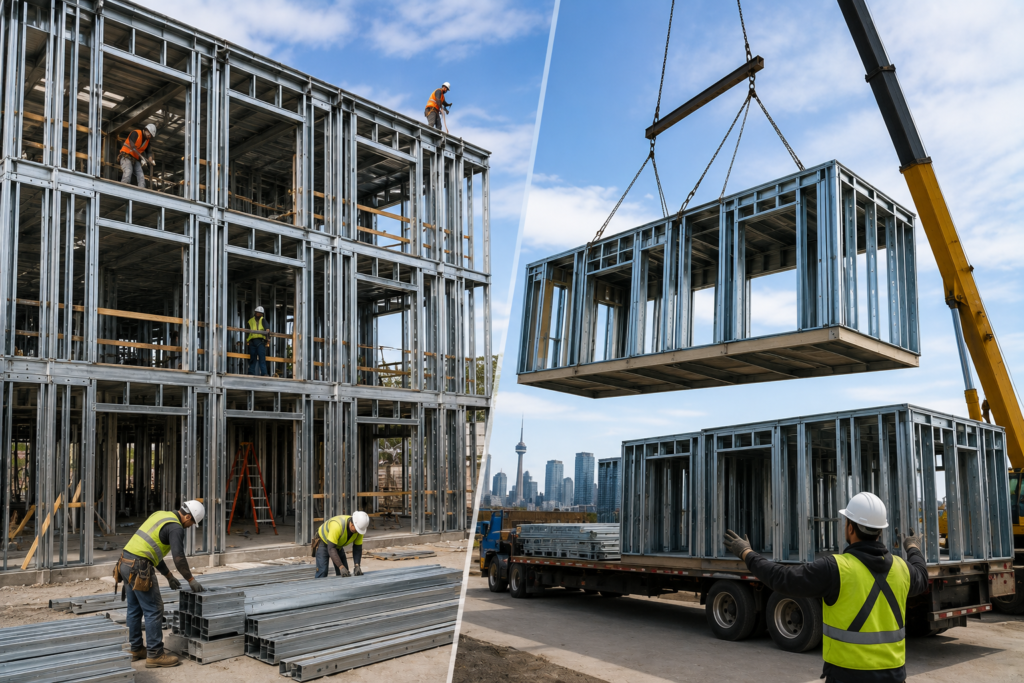
Modular construction is a building method where sections of a structure are manufactured off-site and then assembled on-site.
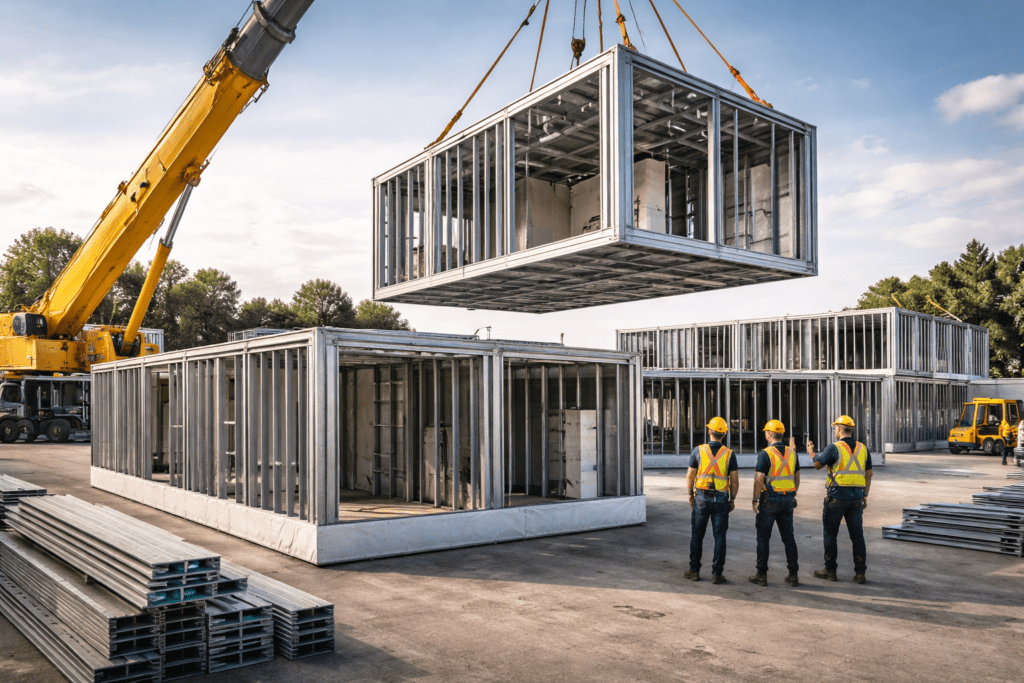
Instead of building everything from the ground up on location, entire wall panels, floor systems, or even full building modules are produced in a factory setting.
Once completed, these components are transported to the site and assembled into the final structure.
This approach reduces construction time, improves quality control, and minimizes on-site disruptions.
Why Modular Construction Is Growing in Canada
The rise of modular construction in Canada is driven by real industry challenges.
Housing demand continues to increase, especially in Ontario. At the same time, labour shortages and rising costs are making traditional construction methods less efficient.
Prefabricated construction addresses these issues by improving speed and reducing reliance on large on-site crews.
Projects that would typically take months can be completed in a shorter timeframe. This makes modular construction particularly attractive for residential developments, multi-unit housing, and commercial projects.
As these benefits become more widely recognized, adoption continues to grow.
The Role of Steel Framing in Modular Systems
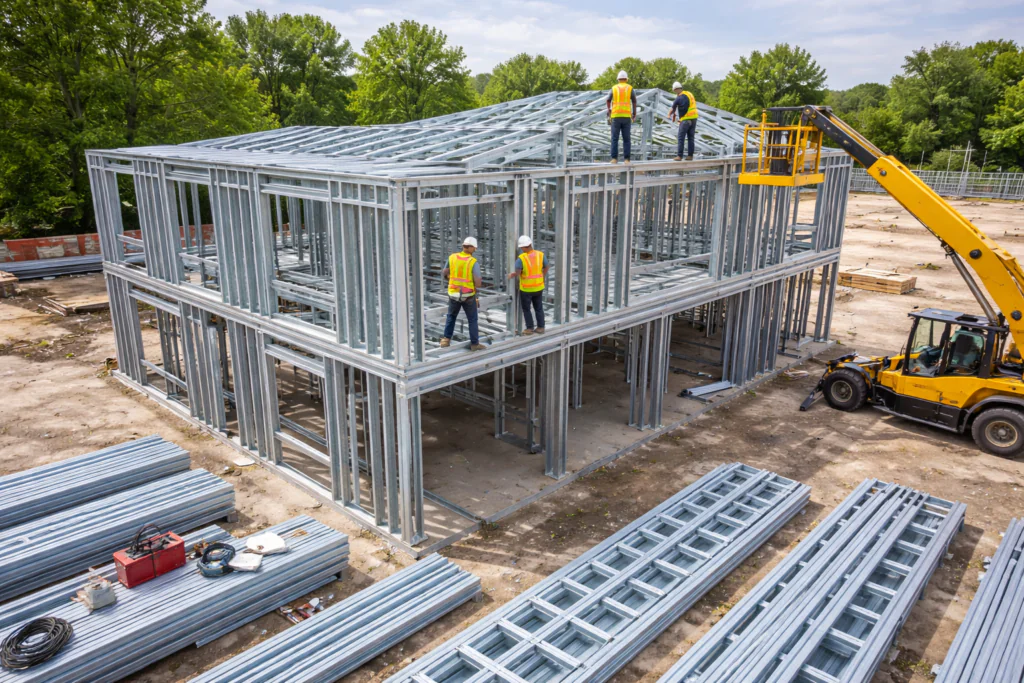
Steel framing is a key component of modular construction. Its properties make it ideal for off-site manufacturing and on-site assembly.
One of the main advantages is precision. Steel components are manufactured to exact dimensions, which ensures that modules fit together accurately during assembly.
Durability is another important factor. Steel does not warp, shrink, or crack, which helps maintain structural integrity during transportation and installation.
Steel framing also supports consistent quality. Since components are produced in controlled environments, there is less variability compared to traditional on-site construction.
These characteristics make steel framing the preferred choice for many modular construction systems in Canada.
Speed and Efficiency Advantages
Speed is one of the biggest benefits of modular construction.
While site preparation is happening, modules can be manufactured at the same time. This parallel process significantly reduces overall project timelines.
Steel framing enhances this efficiency. Its lightweight nature allows for easier handling and faster assembly compared to heavier structural materials.
Because components arrive ready to install, there is less on-site work required. This reduces delays and improves project coordination.
For builders in Ontario, where timelines are critical, this advantage is significant.
Quality Control and Consistency
Quality control is another major advantage of modular construction.
In traditional construction, work is exposed to weather conditions and varying site environments. This can lead to inconsistencies and defects.
Modular construction eliminates many of these variables. Components are built in controlled settings where quality can be monitored closely.
Steel framing further improves consistency. Its uniform properties ensure that each component performs as expected.
This results in fewer errors, less rework, and smoother inspections.
Reducing Labour Dependency
Labour shortages are a growing concern in Canada’s construction industry.
Modular construction helps address this by shifting work from the job site to manufacturing facilities. This reduces the need for large on-site crews.
Steel framing supports this shift by enabling efficient, repeatable production processes.
With fewer workers required on-site, builders can complete projects even with limited labor availability.
This makes modular construction a practical solution for dealing with workforce challenges.
Sustainability and Waste Reduction
Sustainability is becoming a key consideration in construction.
Modular construction reduces material waste by optimizing production processes. Components are manufactured with precision, which minimizes excess material.
Steel framing adds to this benefit. Steel is recyclable and can be reused without losing its properties.
Off-site construction also reduces site disruption and environmental impact.
As regulations become stricter, these advantages will become even more important.
Challenges of Modular Construction
While modular construction offers many benefits, it also comes with challenges.
Transportation of modules requires careful planning. Large components must be moved safely from factory to site.
Design coordination is also critical. Since modules are built off-site, changes during construction are difficult to implement.
Steel framing helps address some of these challenges by providing flexibility in design and ensuring structural reliability.
However, successful modular projects require strong planning and coordination from the beginning.
The Future of Modular Construction in Ontario
Modular construction is expected to continue growing in Ontario over the next decade.
As demand for housing increases and construction pressures intensify, builders will look for more efficient methods.
Steel framing will remain a central part of this shift. Its ability to support prefabrication, improve efficiency, and ensure durability makes it essential for modern construction systems.
Builders who adopt modular construction early will be better positioned to compete in a changing market.
Build Smarter with LSF Pro Structures
Modular construction is reshaping the future of building in Canada, and steel framing is at the core of this transformation.
LSF Pro Structures provides precision-engineered steel framing systems designed to support modular construction and meet Ontario building standards. Every component is built for accuracy, durability, and efficient assembly.
If you want to take advantage of modular construction and deliver projects faster, contact LSF Pro Structures today and build with confidence.