Project schedules define profitability in Canadian construction. Delays increase labor costs, disrupt subcontractor coordination, and strain client relationships.
For builders evaluating structural systems, one question often comes up early:
What is the real cold-formed steel framing lead time Canada builders should expect?
Understanding how steel framing timelines work can help you plan smarter and avoid costly surprises.
Why Lead Time Matters More Than Ever
Canadian construction continues to face:
Labor shortages
Supply chain disruptions
Material volatility
Increased demand for housing
Unpredictable material availability can derail even well-managed projects.
Many builders assume lumber is faster because it is widely stocked. But availability does not always equal reliability. Lumber markets fluctuate, and material quality can vary.
Cold-formed steel framing follows a different model. It operates on engineering precision and scheduled production.
When managed correctly, this often improves schedule certainty.
What Affects Cold-Formed Steel Framing Lead Time in Canada?
Lead time depends on several factors. Builders should understand them early in the design phase.
1. Design Finalization
Steel framing begins with engineering. Structural drawings must be completed and approved before manufacturing starts.
If design changes occur late, production schedules adjust accordingly.
The clearer and earlier your drawings are finalized, the smoother the process becomes.
2. Project Size and Complexity
A single laneway home requires less production time than a multi-unit development.
Complex shear wall layouts, rooftop additions, or mid-rise buildings require more detailing and coordination.
However, once engineering is complete, manufacturing moves quickly and efficiently.
3. Manufacturing Capacity
Reputable cold-formed steel suppliers operate on scheduled production cycles.
Unlike lumber, which depends on stock levels, steel framing is precision-manufactured per project. This reduces variability but requires proper scheduling.
When builders coordinate early, production slots can be secured without delay.
Typical Lead Time Expectations
While timelines vary by project, most Canadian builders can expect:
1–2 weeks for engineering and detailing after final drawings
2–4 weeks for manufacturing, depending on project scale
Scheduled delivery aligned with site readiness
In many cases, total lead time ranges between 3–6 weeks from finalized design to delivery.
Compared to unpredictable lumber shortages or damaged material replacements, steel framing often provides more consistent planning control.
The key factor is early coordination.
Why Steel Improves Schedule Certainty
When evaluating cold-formed steel framing lead time Canada, builders should consider not just production speed but schedule reliability.
Steel framing offers:
Precision manufacturing
Minimal on-site cutting
Reduced material waste
Organized delivery bundles
Faster installation once on site
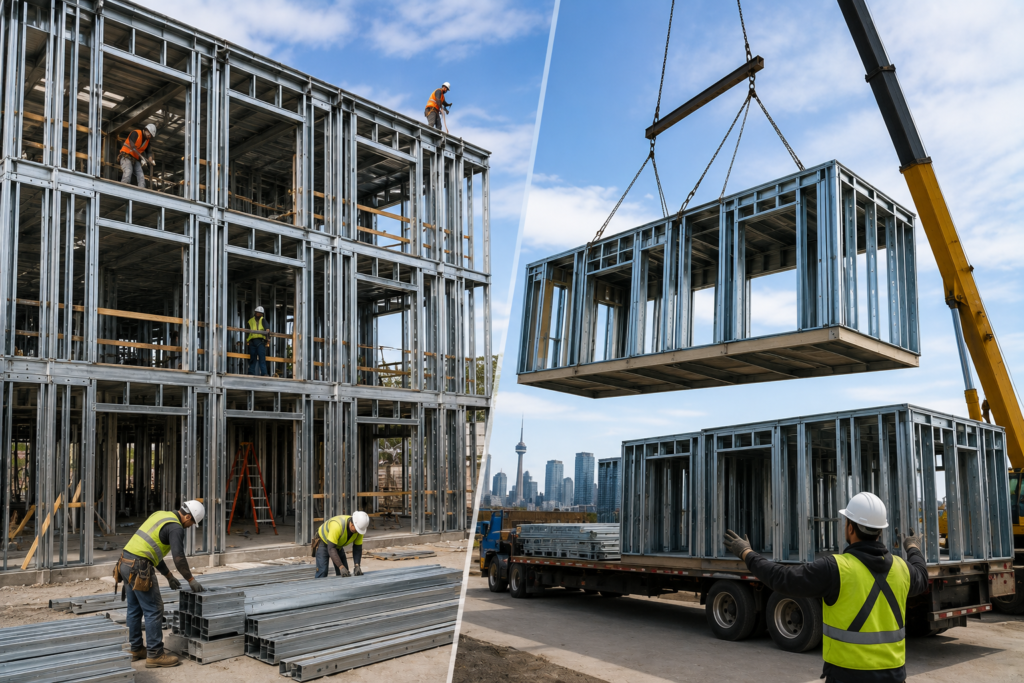
Because components arrive labeled and cut to specification, crews can frame faster with fewer adjustments.
This often offsets the perception that custom manufacturing slows the project down.
In reality, controlled production improves workflow.
Comparing Steel and Lumber Lead Time
Lumber is often available immediately. But that availability can create hidden issues:
Inconsistent quality
Warped or moisture-damaged boards
On-site delays from sorting and cutting
Price volatility between estimate and purchase
Steel framing requires planning, but once scheduled, it delivers predictable output.
Builders who shift from reactive purchasing to structured coordination often see improved project timelines.
In today’s market, certainty often matters more than speed.
How Early Planning Reduces Delays
To optimize lead time for cold-formed steel framing, builders should:
Finalize structural drawings early
Coordinate closely with framing suppliers
Align foundation and site preparation timelines
Avoid late-stage structural revisions
The earlier the supplier becomes involved, the more accurate production scheduling becomes.
This proactive approach reduces stress and protects margins.
How LSF Pro Supports Reliable Lead Times
At LSF Pro, we understand that construction schedules are critical.
We provide:
Clear production timelines during the quoting stage
Engineering coordination support
Precision manufacturing aligned with approved drawings
Scheduled delivery based on site readiness
Our process is structured to reduce uncertainty and improve planning confidence.
If you are evaluating cold-formed steel framing lead time Canada, we can provide realistic timelines tailored to your specific project.
Plan Smarter. Build Faster.
In Canadian construction, schedule control is competitive advantage.
Cold-formed steel framing requires coordination, but it delivers reliability, precision, and predictable timelines when managed correctly.
Instead of reacting to material availability, move toward structured production planning.
Contact LSF Pro today to discuss how our engineered steel framing systems can keep your next project on schedule.