
Steel framing in Canada is not just about material selection. It is governed by strict engineering rules that define how structures must perform under real-world conditions.
At the center of these rules is CSA S136. This standard controls how cold-formed steel members are designed, calculated, and used in construction across Canada.
For builders, engineers, and developers working with light steel framing in Ontario, understanding CSA S136 is essential. It is not optional. It directly affects approvals, safety, and structural performance.
What Is CSA S136?
CSA S136 is the Canadian standard for the design of cold-formed steel structural members. It is published by the Canadian Standards Association and is referenced directly in the National Building Code of Canada.
This standard defines how steel framing systems must be designed to safely carry loads and resist forces such as wind, snow, and structural weight.
Unlike general guidelines, CSA S136 provides detailed engineering methods. It ensures that steel framing systems perform reliably under Canadian conditions.
Any structural steel framing project in Canada must comply with CSA S136 to meet code requirements.
Why CSA S136 Matters in Steel Framing
CSA S136 is not just for engineers. It impacts every stage of a project.
Designers use it to calculate load capacity and structural behavior. Manufacturers rely on it to produce compliant components. Inspectors use it to verify that systems meet required standards.
If a project does not follow CSA S136, it will not pass approval.
More importantly, ignoring this standard can lead to structural failure. Steel framing must behave predictably under stress, and CSA S136 ensures that it does.
How CSA S136 Fits Within Canadian Codes
CSA S136 works as part of a larger regulatory system.
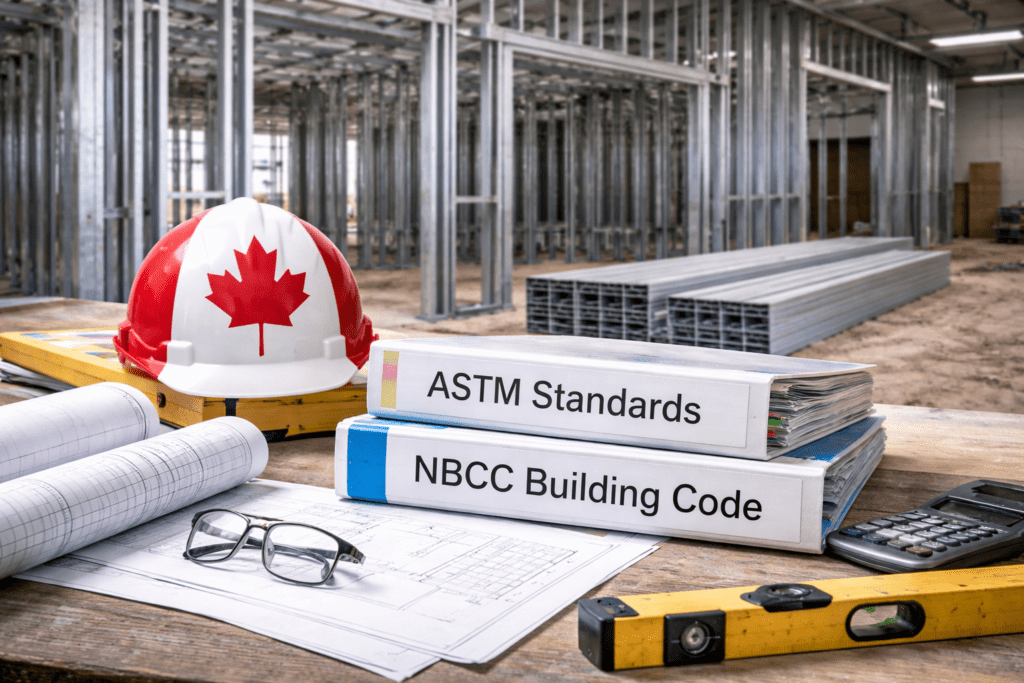
The National Building Code of Canada (NBCC) sets the overall performance requirements for buildings. It defines what structures must achieve in terms of safety and durability.
This code provides the technical rules for how steel framing meets those requirements.
In Ontario, the Ontario Building Code adopts these national standards. This means that CSA S136 is effectively mandatory for steel framing projects in the province.
Understanding this relationship is critical. Builders are not just following one rulebook. They are working within an integrated system.
Key Design Principles in CSA S136
CSA S136 focuses on how cold-formed steel behaves under load. This is different from traditional materials like wood or hot-rolled steel.
One of the main principles is load resistance. Steel framing must support both permanent loads, such as the weight of the structure, and variable loads, such as occupants and furniture.
Snow load is especially important in Canada. Roof systems must be designed to handle heavy accumulation without failure.
Wind load is another major factor. Buildings must resist lateral forces that can cause movement or collapse if not properly designed.
CSA S136 provides formulas and methods to calculate these forces and ensure that the structure can handle them safely.
Member Design and Thickness Requirements
Steel studs and other framing members must meet specific requirements under CSA S136.
Thickness, also known as gauge, plays a critical role. Thicker members can carry more load, but they must still be designed correctly.
The standard defines how to calculate:
- Bending strength
- Axial load capacity
- Shear resistance
It also considers buckling, which is a key concern in cold-formed steel. Because the material is thinner, improper design can lead to instability.
This is why structural steel studs must always be engineered. Guesswork is not acceptable under CSA S136.
Connections and Fastening Rules
Connections are one of the most critical parts of any steel framing system.
CSA S136 defines how components must be connected to ensure stability. This includes screw connections, spacing, and load transfer between members.
Improper connections can weaken the entire structure, even if the studs themselves are strong.
The standard ensures that all parts of the system work together as a complete structure, not just individual components.
Serviceability and Deflection Limits
Structural strength is not the only concern. CSA S136 also addresses serviceability.
This includes how much a structure can deflect or move under load. Excessive deflection can cause problems with finishes, doors, and windows.
The standard sets limits to ensure that buildings remain functional and comfortable, not just structurally safe.
This is especially important in multi-unit residential and commercial projects across Ontario.
Common Mistakes When Ignoring CSA S136
Many issues in steel framing projects come from misunderstanding or ignoring CSA S136 requirements.
One common mistake is using incorrect stud sizes without proper calculations. This can lead to insufficient load capacity.
Another issue is poor connection design. Even strong members can fail if connections are not properly engineered.
Lack of coordination between design and installation teams also creates problems. If installers do not follow engineered drawings, the system may no longer meet CSA S136 requirements.
These mistakes often result in failed inspections, delays, and costly corrections.
Why CSA S136 Is Critical for Builders in Ontario
In Ontario, compliance with CSA S136 is closely tied to project success.
Inspectors expect steel framing systems to match engineered designs. If they do not, work may be rejected.
Builders who understand this code gain a clear advantage. They can coordinate better with engineers, avoid mistakes, and move through inspections more efficiently.
In a competitive construction market, this level of control can significantly impact timelines and profitability.
The Future of Steel Framing and CSA S136
As steel framing becomes more common in Canada, CSA S136 will continue to play a central role.
Advancements in design software and prefabrication are making it easier to apply these standards accurately. This improves both efficiency and reliability.
Builders who adopt these systems and understand the rules behind them will be better positioned for future growth.
CSA S136 is not just a requirement. It is a framework for building smarter and more efficiently.
Build with Confidence Using LSF Pro Structures
Understanding CSA S136 is essential, but applying it correctly requires experience and precision.
LSF Pro Structures delivers engineered steel framing systems that fully align with CSA S136 and Ontario Building Code requirements. Every component is designed to meet structural standards and simplify the construction process.
If you want to ensure your project meets all design rules while staying efficient and reliable, contact LSF Pro Structures today and build with confidence.